Surely it has happened to you: your team starts an Agile project with enthusiasm… and, after a few months, meetings become eternal, energy drops and motivation disappears.
The paradox is clear: we seek agility to adapt, but we often end up with teams exhausted and organizations lacking freshness.
The good news: it doesn’t have to be this way. Sustainable Agile means moving forward at a steady pace, taking care of the team’s motivation and resilience.
As we say at SmartWay VP: “The real success of Agile is not in speed, but in the ability to move forward without burning anyone along the way.”.
In this article we will see how to apply Agile and sustainability in teams to drive results without wear and tear. We begin.
Agile and sustainability: the powerful combination that keeps teams alive
When we talk about agile and sustainability in teamsIt is not only about meeting objectives, but also about doing it in a way that takes care of the most valuable capital: people.
- Traditional Agile: prioritizes speed, short deliveries and constant adaptation.
- Sustainable AgileSustainable Agile: adds to all of the above a clear focus on resilience, sustainable performance and team wellbeing.
A key nuance arises here: corporate corporate sustainability is not just about the environment, but about an organization’s ability to sustain results without exhausting its teams. People are the engine of sustainability; without them, no model works.
Invisible challenges that wear out Agile teams
When we talk about agile and sustainability in teamsThere are a number of obstacles that are not always visible at first glance, but that undermine motivation and performance over the months. They are those little “invisible enemies” that turn a good intention into a source of attrition.
- Invisible overloadIt’s not just a matter of too many tasks, but of how they pile up. Meetings that should be short are stretched out, sprints are chained together without a break, objectives are added without removing the previous ones. Little by little, the agenda fills up to such an extent that the team feels like it is always running, but never reaches the finish line. .
- Confusion between rapidity and precipitation: In Agile, there is a lot of talk about delivering early and often. The problem arises when this philosophy is confused with getting work out the door, without taking care of quality. We deliver more, yes, but each delivery generates technical debt, errors or rework.
- Lack of human metrics: What you don’t measure, you don’t manage. Many organizations measure only speed, number of stories completed or turnaround times. But few incorporate indicators of satisfaction, energy or team motivation.
The result: “40 user stories delivered this month” is celebrated, but no one asks if the team is burned out, frustrated or even thinking about leaving the company. And that, sooner or later, ends up affecting the business.
We have seen how this pattern repeats itself continuously: companies that implement Scrum with enthusiasm, hire Agile coaches, fill their walls with colorful post-its… and, after six months, burnout appears as a silent enemy.
The lesson is clear: without awareness of these invisible challenges, Agile can become a sprint to exhaustion rather than a conscious marathon toward sustainability.
Detecting challenges is only the first step. The next, and most important, is to learn how to avoid them on a daily basis with concrete practices.
Essential keys to sustainable Agile and resilient teams
In order for Agile to be sustainable in resilient teamsIt is not enough to implement frameworks. It takes a change of mindset: moving from an obsession with speed to a search for long-term balance. Here are some practical keys:
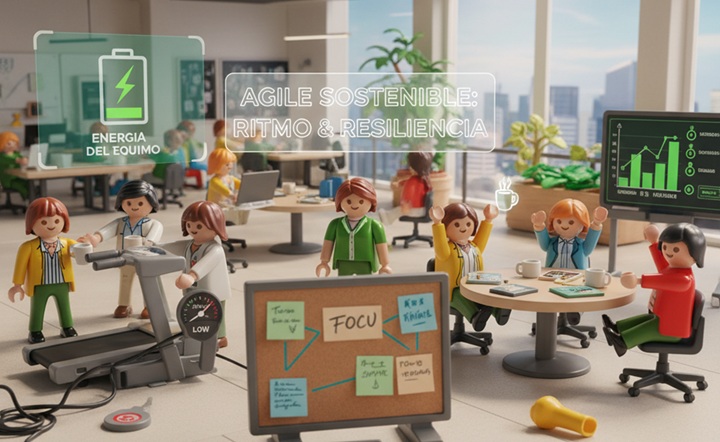
- Sustainable paceAs the official Scrum Guide reminds us, a team must be able to maintain a constant pace indefinitely. That means accepting that you can’t always work at 100% capacity. Forcing teams to give their all sprint after sprint is like running a marathon at 100-meter pace: the fall is inevitable.
- Planned microbreaksWe are not talking about vacations, but about moments of disconnection integrated into the Agile framework itself. A coffee break after the day, a light retrospective in the open air or a “no meetings day” per month can make all the difference. When these spaces are respected, the team’s energy does not erode and creativity remains active.
- Radical prioritization: Not everything in the backlog is of equal value. Practicing radical prioritization means saying “no” to ancillary tasks to focus on what really moves the business needle and supports sustainable performance. le.
- Well-being metrics: Speed and number of deliveries are important, but not enough. A team also needs to measure its mood: morale, energy and motivation. Small anonymous surveys or simple check-ins on the daily help to detect warning signs before it’s too late.
A “how do you get to the sprint?” scored from 1 to 5 can provide more value than a burndown chart. - Continuous feedback: Feedback should not be limited to formal retrospectives. It’s about creating a culture where teams (and individuals) can raise their hands at any time to say, “this isn’t working” or “we need to adjust this other thing.” When the team’s voice is truly heard, Agile frameworks cease to be an imposition and become a tool for shared growth.
Best practices for leaders and teams
- Radical transparency: talk openly about workloads.
- Realistic OKRsConnect business objectives with real team capabilities to ensure sustainable performance (read our article on how to implement OKRs in 4 steps).
- Sustainable backlog: keep a backlog alive, but with focus, avoiding accumulating tasks that no one will do (here you can read more about our post on product backlog management).
- Clear user stories: each well-defined user story reduces the mental workload (see how to do this in our article on agile user stories).
- Celebrate small achievementsReinforce motivation without waiting only for the end of the project.
Conclusion: the real power of Agile is in its sustainability.
Agile should not be a sprint, but a conscious marathon. Organizations that manage to integrate sustainability into their way of working not only deliver better products, but build resilient and happy teams.
Because in the end, innovation does not come from exhaustion, but from the renewed energy of teams that feel cared for.
Sustainable Agile is not just a methodology, it is a mindset that allows you to go far without losing anyone along the way.
The corporate sustainability is not achieved by running faster, but by learning to run together, at the right pace and with the energy to go far.
If you want to continue learning how to build resilient teams and achieve sustainable performancesubscribe to our newsletter The Smart Drop. A space with practical ideas, real examples and reflections to transform the way you work.