
If you are reading this, it is probably because you are a pragmatic person who wants to know if Agile is a fad or if it can really help you in your day-to-day life.
Here are 2 considerations:
- Agile is NOT a fad, Agile was named in 2001. If it is a fad, it is lasting a long time and it is being very useful for companies and teams to improve.
- Second, “Agile” WILL help you.
“we work in a customer service team” Can help you
“I grow asparagus in hydroponics”, can also help you.
Here is how I apply point 3 to achieve my objectives:
In today’s article I am going to share with you several examples of Agile methodologies applications that can help you in your life. Yes, both in your work life and in your personal life.
I could give you many examples of Agile methodologies applications, but I will share 3 and let’s apply one of the first ones to ourselves: PRIORITIZE.
Example Agile Methodologies 1: Prioritize
Prioritization is a fundamental tool in Agile methodologies:
If everything is urgent, nothing is urgent
We live in an “amazon Prime” world, we want things for NOW and we want everything. And this is NOT always possible: we have 2 hands and 16 hours a day (sleeping 8 hours is to extend our life).
Prioritization is our best ally to improve productivity. Not all the tasks we have pending have the same importance, or the same impact. There will be some that will be more important or that their completion will produce greater impact (or happiness) than others, this is obvious. The difficulty lies in distinguishing them and the challenge lies in stopping and dedicating some time to classify them.
Ideally, prioritization should be based on value, but what is value? Value is a subjective concept, as it depends on each recipient. If we talk at team level in a work environment, value can be the number of new subscribers per new feature, or the number of customers satisfied with the quality of the products, or those who will buy again, or … Each environment defines its own criteria of value, in any case, this must be known by all team members who will work on producing it.
On a personal level, value is also totally subjective. For some people value will be the income it generates, for others the degree of self-satisfaction, also the level of happiness in others, etc. In these cases we should ask ourselves: What do we expect our “work” to produce?
Productivity is about providing the maximum value with the least amount of effort. This requires clear prioritization criteria. Learning where and when to invest energy saves time and money.
The amount of requests that can come to us can overwhelm us, it can become a huge list of things to do but our time is finite, so the only option is to prioritize. To do this we have 2 or 3 steps to take:
- Apply Pareto’s law.
- (optional but recommended) re-apply Pareto’s law to the result of step 1
- Prioritize the above outcome based on value/impact.
It is interesting to master tools that allow us to prioritize with sense, apart from “Pareto”, it is interesting to master the Eisenhower matrix.
I don’t have time
Sometimes we use the excuse “I don’t have time” to mask that a task is a low priority for us. To me, the “I don’t have time” excuse can be part of a self-deception. For example, “I never clean the blinds because I don’t have time” and if you were offered 100.000€ to clean the blinds, would you have time then? Possibly yes… It’s not that you don’t have time, it’s that it’s not your priority!
Eisenhower Matrix
The Eisenhower matrix is a graphical representation of the different levels of importance and urgency of a specific task. According to the urgency and importance we can distinguish between 4 states, or 4 levels of task classification:
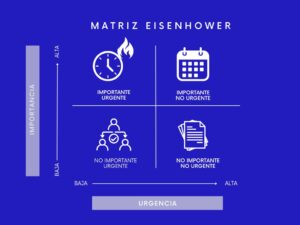
– Important and Urgent
– Important and Non-urgent
– Urgent and Not Important
– Non-urgent and Non-important
Urgency” is defined as that which requires immediate attention. And “Important” is defined as contributing to your medium and long-term goals, to your life purpose.
The Eisenhower matrix divides the tasks into 4 quadrants according to the two previous parameters:
- Area I (Important and Urgent): Urgent problems or imminent crises are usually placed in this area. Also key projects for the company whose deadline is close to being reached. Although it may seem counterintuitive, this quadrant is the one to which we should dedicate the least time, since it would mean that we have not planned our efforts well or have not prioritized our most important work, or we are in an environment where we are continuously attending to emergencies.
- Area II (Important, but NOT urgent): In this quadrant we have the tasks that will help us achieve our goal. The most effective people spend most of their time working on elements of this quadrant. Effective people are not problem/urgency oriented but opportunity oriented and act proactively. In this quadrant we are allowed to plan, prepare and build relationships: it is where quality work happens.
- Area III (NOT Important and Urgent): It is often confused with the first quadrant since urgent tasks are urgent when they appear. In this quadrant we usually find interruptions, calls, e-mails, meetings… Many times we rush to solve problems without considering their importance. Sometimes, the pressure to solve them as soon as possible comes from the expectations and interests of other colleagues, but they do not correspond either with our agenda or with the company’s interests. It is essential to know how to say “no”. And with the prevailing addiction to the urgent, this is not easy.
- Area IV (NEITHER important NOR urgent): As is obvious, this quadrant is the least interesting of all and the tasks in it only tasks that should be addressed when all others have been resolved. In most cases, tasks in this quadrant should be delegated or eliminated.
In our day-to-day task management, we tend to get lost in the urgent without stopping to identify their importance. The Eisenhower matrix can help us to place/classify the tasks in each of the quadrants before starting to work on them.
Example Agile Methodologies 2: Gain focus and productivity with Pomodoro
Continuing with examples of Agile methodologies, it should be noted that a very interesting aspect of Agile methodologies is that they promote focus.
We tend to think we can multitask, but we can’t. We are not multitasking: WE ARE NOT MULTITASKING.

Several studies have shown that multitasking, or the ability to multitask, is actually a myth for most people. Instead of performing two or more tasks simultaneously, the human brain rapidly switches from one task to another, which comes at a cost in terms of time and mental energy. This constant switching between tasks can lead to lower productivity, frequent errors and greater mental exhaustion(Asana).
Most people cannot multitask effectively, and only a small percentage (about 2%) of the population, known as “supertaskers,” have the ability to efficiently handle more than one task at a time due to differences in their brain activity(UOC). However, for the rest of the population, multitasking often results in lower performance, memory problems, and increased stress, as the brain is not designed to divide its attention effectively between simultaneous tasks(US News Update).
Therefore, it is advisable to focus on one task at a time to improve efficiency and reduce the negative effects associated with multitasking. This includes minimizing distractions and setting clear priorities in daily activities.
Pomodoro
The Pomodoro technique is used to improve focus. It consists of using temporary windows, i.e., time periods of limited duration, during which only one element is worked on.
This tool is very practical when performing work that requires concentration over a period of time.
We set a period of time, typically 20-25 minutes, during which interruptions or notifications are disabled. We focus on doing THAT ONE THING we want to do. After those 20-25 minutes, we have 5 minutes to devote to other matters, whether it is reading and answering emails, whatsapps, resting or any other task.
It is not a matter of doing a single Pomodoro of 25 minutes of work plus 5 minutes of disconnection, but of chaining Pomodoros.
By the way, the name Pomodoro (tomato in Italian), comes precisely from the typical tomato-shaped kitchen timers used by the student who invented the method to help himself to study without losing concentration.

The brutal thing about this technique is to take it to the team level, to have the whole team working on something without interruptions. Try it and let me know!
Example Agile Methodologies 3: Visualizing the work
If your boss is already in love with the improvement of your productivity with the 2 previous examples of Agile methodologies, with this one he already puts your picture on the wall. It’s all about visualizing the work to be done.
About 90% of the information transmitted internally in the human brain is visual.
The human being is a visual animal. Humans discover, organize and recreate reality, acquiring awareness of it through perception. It is said that 80% of the information we receive from our environment enters through our eyes.
Research conducted by 3M Corporation concludedthat visual information is processed by the human brain 60,000 times faster than text format. Images are the easiest things for our brains to remember and are fundamental to our learning. In fact, popular wisdom says that “a picture is worth a thousand words”. For human beings, what we see has a profound effect on what we do, what we feel and who we are.
In view of these data, it seems absurd not to make use of visual elements to organize our work.
I do it in my life, and here’s how: TEDx Talk
Visualization is a great tool to deal with the complexity of our environment. Kanban boards are a very useful tool to visualize workloads, tasks or pending tasks or the different states of a task.
In addition, they allow us to map and visualize the workflow.
It can be implemented on a whiteboard or a cork board or wall or any surface that allows us to visually manage the work elements.
The board is divided into columns and rows. Each column represents a step in the process and the rows can represent different types of specific activities. The most common are “To Do”, “Doing” and “Done”.

Use notebooks yes, but NO!
There are many people who use notebooks to visualize pending work, but for this method to be effective it requires more time and redoing work already done. Let me give you an example:
We are very stressed because we have a lot of things on our minds that we have or want to do, or just feel like doing. We take a notebook and empty our head and we feel relaxed. As we complete tasks we cross them out, but the order in which we do them is probably not the same as on paper. In fact, it could be that we come up with new tasks that we add to the end of the list. So we keep working, completing tasks and writing down new ones as they come up. The challenge comes when we reach the end of the page. What do we do? We continue writing in the next page, but what about the tasks not crossed out? We have two options, we leave them on the first page, so it will be necessary to go back and forth to review the tasks to be done, or we copy the pending tasks from the first page to the second page.
In the first case, we are losing the ability to see all the tasks we have to perform at a glance. In the second case, the rework of retyping them adds no value and is a waste of time.
It is for these reasons that I advise against the use of notebooks for task management.
Conclusions
In this article I will tell you 3 examples of the application of tools within Agile methodologies that will help you improve productivity.
You can use one or two, or even combine all 3 and if you do it right it will amplify the results twice as much as you think.
We must visualize all the work, prioritize what we are going to work on and avoid working on many things at the same time.