
Have you ever wondered how great companies have managed to consolidate in their industry? Well, their successes probably started with a clear and well-defined plan.
The Business Model Canvas, created by Alexander Osterwalder, has become one of the most widely used tools by companies of all kinds, from startups to large corporations, thanks to its simplicity and effectiveness. This tool allows you to capture the key ideas of your business on a single canvas, facilitating strategic decision-making and adaptation to market needs.
In this article, we explain how it works, its main components, and how to apply it so that your business also has a clear path to success. We will also see how it can be adapted to empower startups.
Key elements of the Business Model Canvas
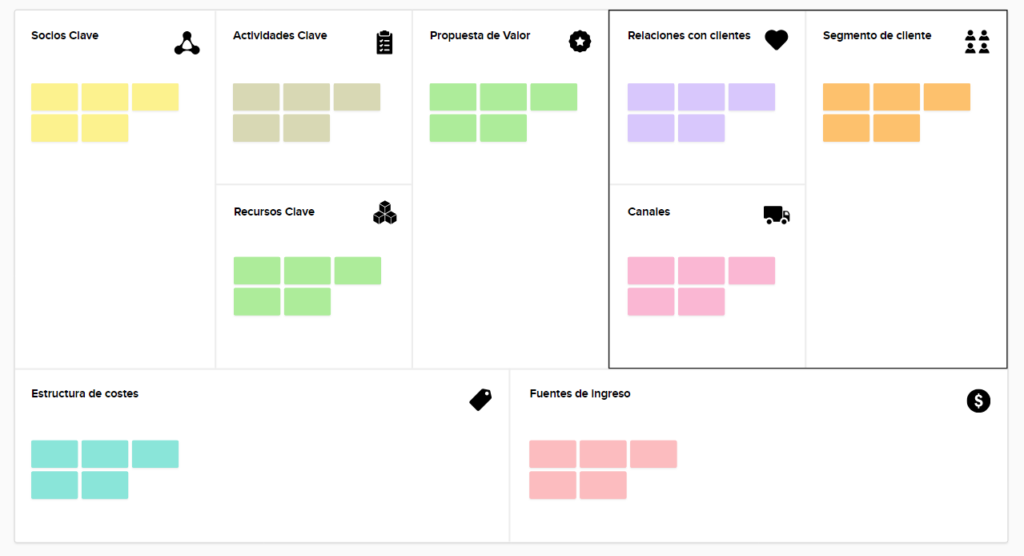
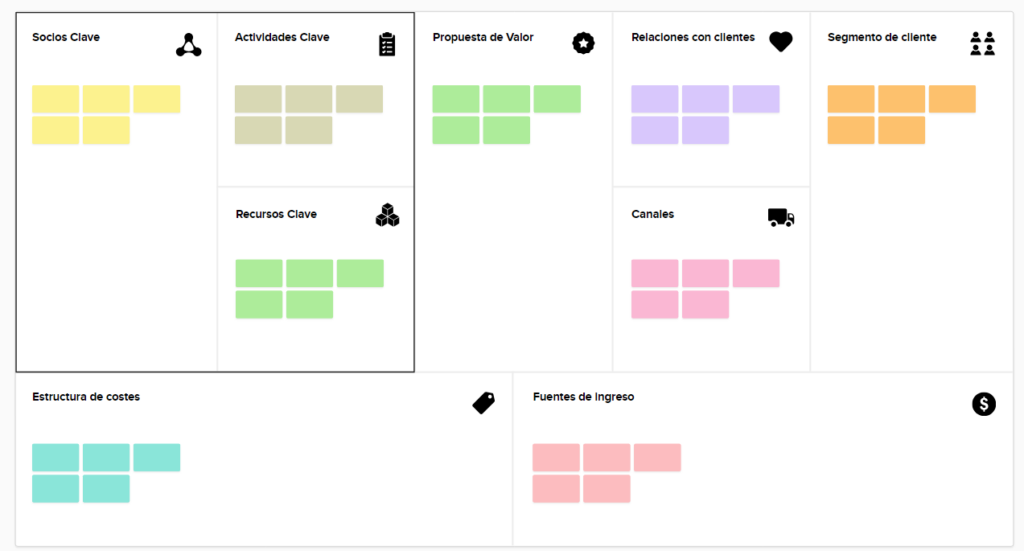
The Business Model Canvas shows the key aspects of the business in nine sections. These sections can be grouped into four main areas: Customer, Offering, Infrastructure and Economic Viability. This classification allows you to see how each part of the business connects to the others, forming a complete system that makes it work. From how you relate to your customers and what you offer them, to how you manage your resources and finances, these areas give you a clear picture of what drives your business. To draw the Business Model Canvas, you can use any tool on the web for interactive work. Here is the one I use https://www.mural.co/templates/business-model-canvas-workshop
Customer
This area analyzes everything related to the target audience of your business, that is, the people or companies you are trying to reach with your business model.
- Customer segments: Clearly defining who your solutions are aimed at is critical. This includes identifying different types of customers, from mass consumers to specialized niches. A business may have multiple customer segments with specific needs.
- Customer relationships: How do you plan to interact and build relationships with your customers? It can be through personalized attention, automated service, or even communities and self-service.
- Channels: Channels are the means through which you reach your customers and deliver your value proposition. This includes both physical channels (stores, distribution) and digital channels (websites, apps, social media).
Offer
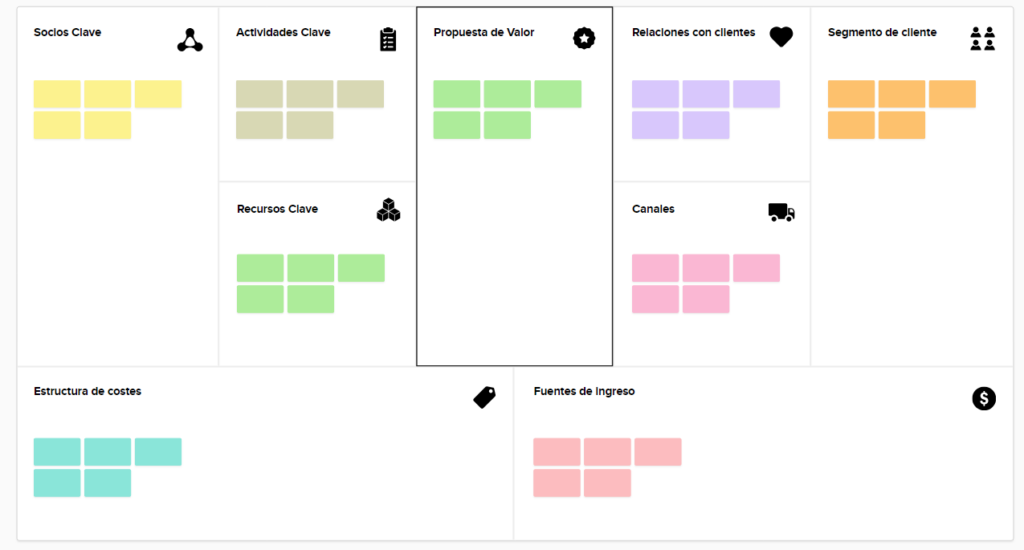
At the core of the Business Model Canvas is the value proposition, the element that distinguishes your company from the rest and the main reason why customers choose your solution.
- Value proposition: It is what your company offers to solve the problems or satisfy the needs of your customers. It is essential that this proposition is aligned with the expectations and desires of the market segment you are targeting. It can include factors such as innovation, customization, efficiency or simply a competitive price.
Infrastructure
The infrastructure covers everything you need for your business to run efficiently and sustainably.
- Key activities: These are the most important tasks that must be carried out for your value proposition to materialize. These activities may vary depending on the type of business, but they will always be related to the production, delivery or support of the solution.
- Key resources: Here are the assets that are essential to operate. They can be physical, human, financial or technological resources. Without these resources, your business would not be able to offer its value proposition or reach its customers.
- Key partners: No business operates in isolation. Suppliers, strategic allies or collaborators that help optimize operations and reduce risks must always be taken into account.
Financial viability
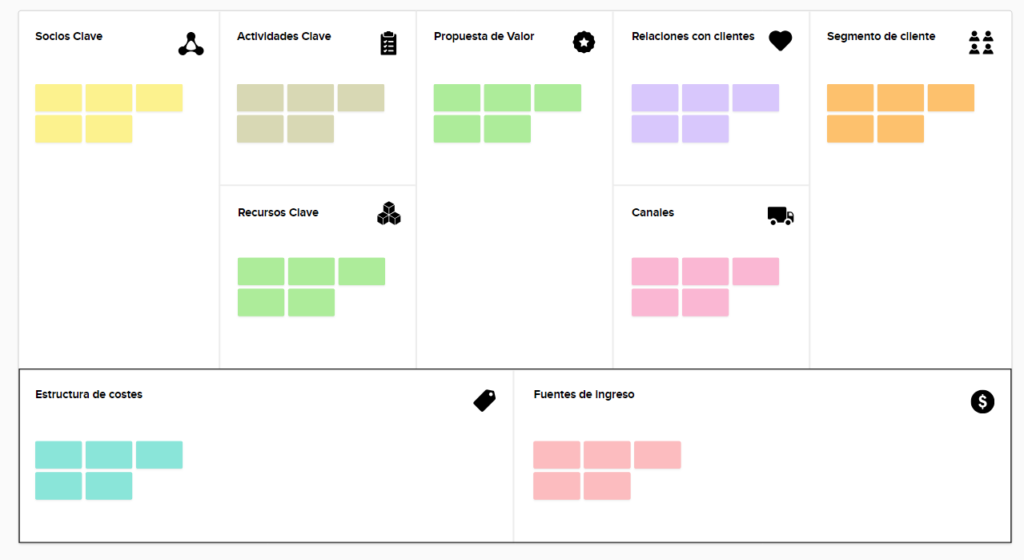
For a business model to be sustainable, it must generate more revenue than it spends. Therefore, the Business Model Canvas also analyzes how the cash flow of the business is structured.
- Cost structure: This includes all costs associated with the operation of the business, including production, marketing, distribution and any other relevant activities.
- Revenue sources: Revenue sources can vary from direct product sales to subscription, licensing or commission models.
How to apply the Business Model Canvas in your company
Undoubtedly, each and every sector is important and will be key to evaluating the success of the business model. In fact, the Business Model Canvas is synthesized in such a way that only the essential information can be used to carry out the evaluation. Among the sections where companies find it most difficult to define, Market Segmentation and Value Proposition are often highlighted.
How to use the Business Model Canvas to identify target audiences
Segmenting the market gives you a clear view of how to connect the specific needs of different customer groups to your business model, allowing for more focused and efficient strategies.
- Identify your key customer groups: Define who you want to target, segmenting by customer type (B2B, B2C…).
- Sort by common characteristics: Use criteria such as demographics, psychographics or behavior to group your customers.
- Prioritize the most valuable segments: Focus your efforts on the customers with the highest revenue potential or impact. Try to prioritize the TOP 3 segments you will want to address.
- Detect their needs: Investigate specific problems and needs to better adapt your offer.
How to integrate the value proposition in the Business Model Canvas
The value proposition is one of the key elements of the Business Model Canvas, as it defines how your solution satisfies customer needs and adds value to them. This will help you to be clear about what your company will offer as a solution to your target customer’s problems.
- Solve specific needs: Define what problems you solve for each customer segment you have prioritized in your business.
- Differentiate yourself from the rest: Highlight what makes you unique from the competition.
- Focus on tangible benefits: Show concrete results obtained by customers (savings, efficiency…).
- Validate your proposal: Test your offer with real customers to adjust and improve.
When integrating the value proposition into the Business Model Canvas, be sure to reflect its impact on other building blocks, such as channels, customer relationships and revenue streams. This way, you will have a holistic view of how your value proposition connects to the rest of your business model.
Evolution of the Business Model Canvas: Introduction to Lean Canvas
With the essence of Lean Startup, Ash Maurya adapted the Business Model Canvas for startups and early stage businesses. This is where the Lean Canvas comes in, a simplified variant that allows you to validate your business model quickly.
Key differences between Lean Canvas and Business Model canvas
Although both models share a similar structure, the Lean Canvas and the Business Model Canvas have important differences:
- Lean Canvas focuses on key problems, solutions and metrics, making it more agile and focused on validation.
- Business Model Canvas encompasses broader aspects of the business, such as relationships with customers and key partners.
In short, unlike the Business Model Canvas, which focuses more on an overall view of the business, the Lean Canvas puts the focus on specific problems, quick solutions and key metrics.
When to use Lean Canvas
The Lean Canvas is especially useful when:
- You are launching a startup or a new product and need to quickly validate if your idea has potential.
- You need to focus on the most pressing issues facing your customer and how to solve them effectively.
- You are looking for a more agile and direct approach that allows you to experiment and learn quickly, without investing time in the more complex details of a consolidated company.
If your priority is to validate ideas, understand your customers’ problems in depth and generate quick solutions, the Lean Canvas is a better tool than the Business Model Canvas.
How to apply the Lean Canvas in your startup
Unlike the Business Model Canvas, the Lean Canvas places a strong emphasis on identifying problems and solving them for different customer groups. These are its sections:
- Problem: Identify and prioritize the most critical problems facing your customers.
- Customer Segment: Define who your key customers are and group them into specific segments.
- Unique Value Proposition: Explain what makes your solution unique and why it is better than the competition.
- Solution: Describe how your product or service effectively addresses the identified problems.
- Channels: Determine the means through which you will reach your customers and deliver your solution.
- Revenue Streams: Define how you will generate revenue from your customers and what your revenue streams will be.
- Cost Structure: Identify the most important costs associated with the operation of your business.
- Key Metrics: Establish the indicators that will allow you to measure the success and progress of your business.
- Competitive Advantage: Highlight any unique advantages that differentiate you from the competition and are difficult to replicate.

If you want to know more about startups, I invite you to read the following article: Agile Startup: The Revolutionary Methodology for Emerging Companies – Smartway