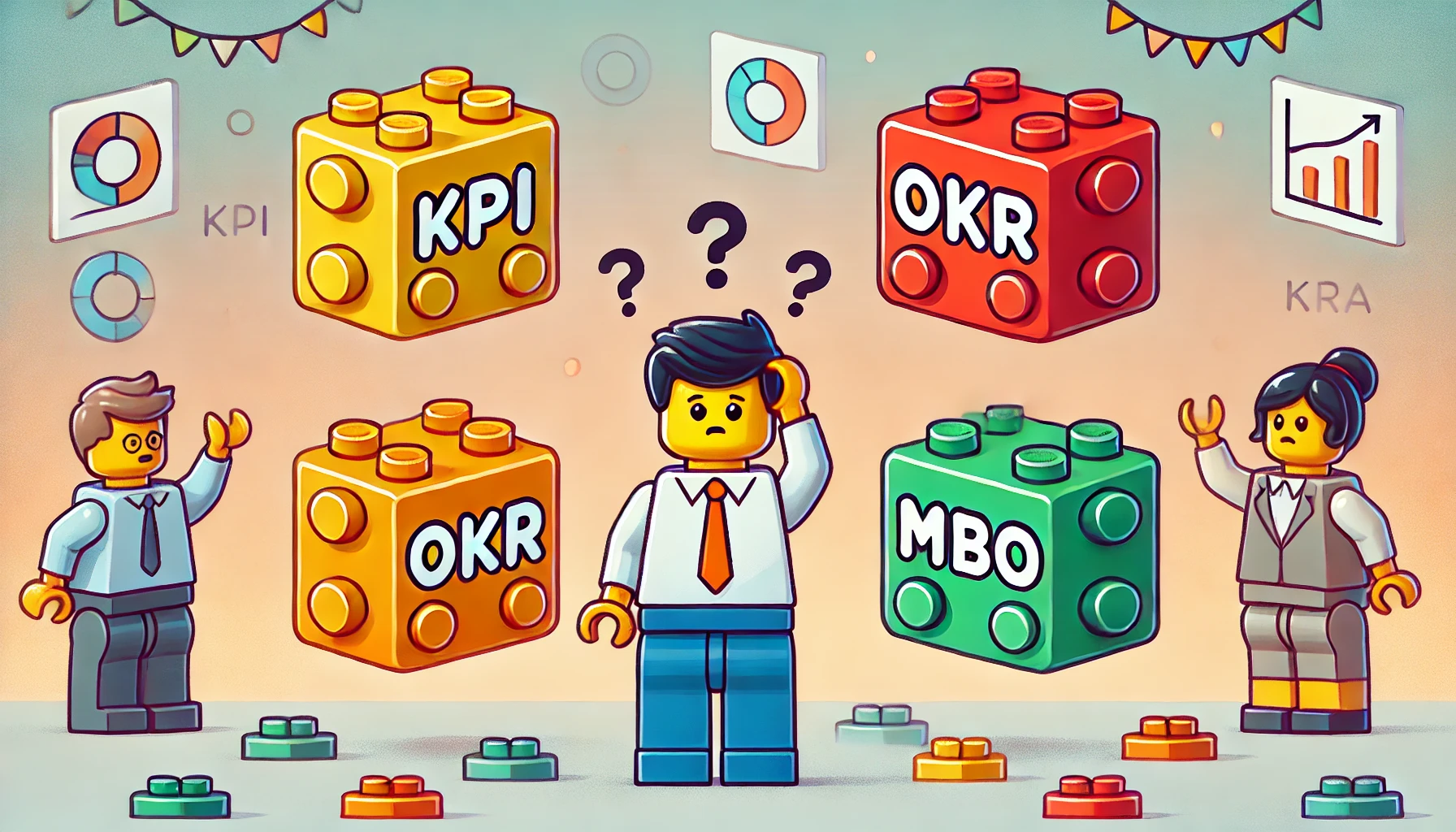

Common OKR implementation mistakes: 5 key pitfalls and how to avoid them successfully
Has it ever happened to you that you start a new system with enthusiasm and, after a few weeks, you notice that the team goes back to the same old dynamics? This often happens with OKRs. Not because the framework is poorly designed, but because many organizations run into the same common OKR implementation mistakes.
The good news is that these are not insurmountable problems. They are predictable failures that, if you know about them, you can avoid so that OKRs stop being a “wet paper” exercise and become a tool that generates focus and real motivation. Let’s get started.
What are OKRs and why are they worthwhile?
OKRs (Objectives and Key Results) were born at Intel and became known worldwide thanks to Google. They are not a passing fad: thousands of companies use them today because they help connect strategy with the daily actions of the teams.
Its logic is simple:
Objectives → what we want to achieve (inspiring, challenging, clear).
Key results → how we will know if we are going in the right direction (measurable, specific and verifiable).
Unlike other frameworks, OKRs are not looking for you to measure what you already do, but to push you a little further. And therein lies the challenge: if you apply them without understanding the spirit, common implementation mistakes appear.
Common OKR implementation errors: mistaking them for tasks
Imagine your software company defines an OKR as:
❌ “Do three customer meetings every week”.
That’s not an OKR, that’s a task. The real goal was:
✅ “Increase customer satisfaction by 20%.”
The difference is enormous: the first is to meet a schedule; the second is to achieve real impact.
Tip: every time you write a possible key result, ask yourself if it measures impact or if it is just an action. If it’s the latter, it’s not an OKR.
Common OKR implementation mistakes: setting too many objectives
Initial enthusiasm often leads to filling a document with 7, 8 or even 10 objectives. It sounds ambitious, but in practice the team ends up scattered and exhausted.
The official Scrum Guide reminds us of something basic: focus. Less is more.
Maximum 3 objectives per cycle.
Each with 2 to 4 key results.
Think of it this way: if everything is a priority, nothing is.
Failure to align OKRs with overall strategy
Another of the most damaging mistakes is to create OKRs in parallel to the company’s strategy. This leads to teams working hard… in different directions.
Hypothetical example:
Global strategy: Expand operations in Europe.
OKR marketing: Increase engagement on TikTok by 30%.
Where do they intersect? Probably nowhere.
Tip: each OKR should clearly answer how it helps the overall strategy. If you don’t find the connection, it’s time to rethink it.
Failure to provide continuous follow-up
Defining OKRs in January and revising them in March is like setting a course on the GPS and then turning off the screen. You may get there, but you usually get lost along the way.
OKRs need to be reviewed on an ongoing basis:
Weekly check-ins.
Monthly reviews for adjustment.
Total transparency: anyone in the company can see the status of the objectives.
Integrating them into weekly meetings makes them no longer an “extra” document but part of the team’s life.
Mistake 5. Using OKRs as a punishment tool
If OKRs become a kind of quarterly exam, people will play it safe. That is: easy targets, zero risk and zero learning.
Google recommends that your compliance rate should be between 60% and 70%. More means you’re not challenging yourself enough.
Tip: celebrate progress and learning, do not punish what was not 100% achieved. This is the only way to generate a culture of continuous improvement.
Practical tips to get out of the error loop
Define impact, not actions.
Focus: three objectives are more than enough.
It connects each OKR to the overall strategy.
Make them visible and check them frequently.
Remember that failure is part of learning.
How OKRs fit with agility
OKRs shine even brighter when you integrate them with agile practices:
In Scrum, they can guide the Sprint Goal and make sense of the backlog.
In Kanban, key results can be displayed on the board.
In retrospectives, they allow you to evaluate not only what you did, but the impact it generated.
If you want to get the objectives down to the ground, I recommend you read our article on agile user stories. It is the piece that connects vision and execution.
Conclusion: from mistakes to learning
We have all made some of these common mistakes in OKR implementation. The key is not to avoid them forever, but to learn quickly from them and adjust course.
A well-worked OKR is not an Excel table that is stored in a folder. It is a living compass that gives meaning to daily work and connects teams to the company’s strategy.
Remember: the value is not in “delivering 100%”, but in learning, focusing and growing together.
Want more practical ideas to transform the way you work with OKRs and agile methodologies?
➡️ Subscribe for free to our newsletter The Smart Drop and receive in your inbox clear, applicable and 100% human advice.