
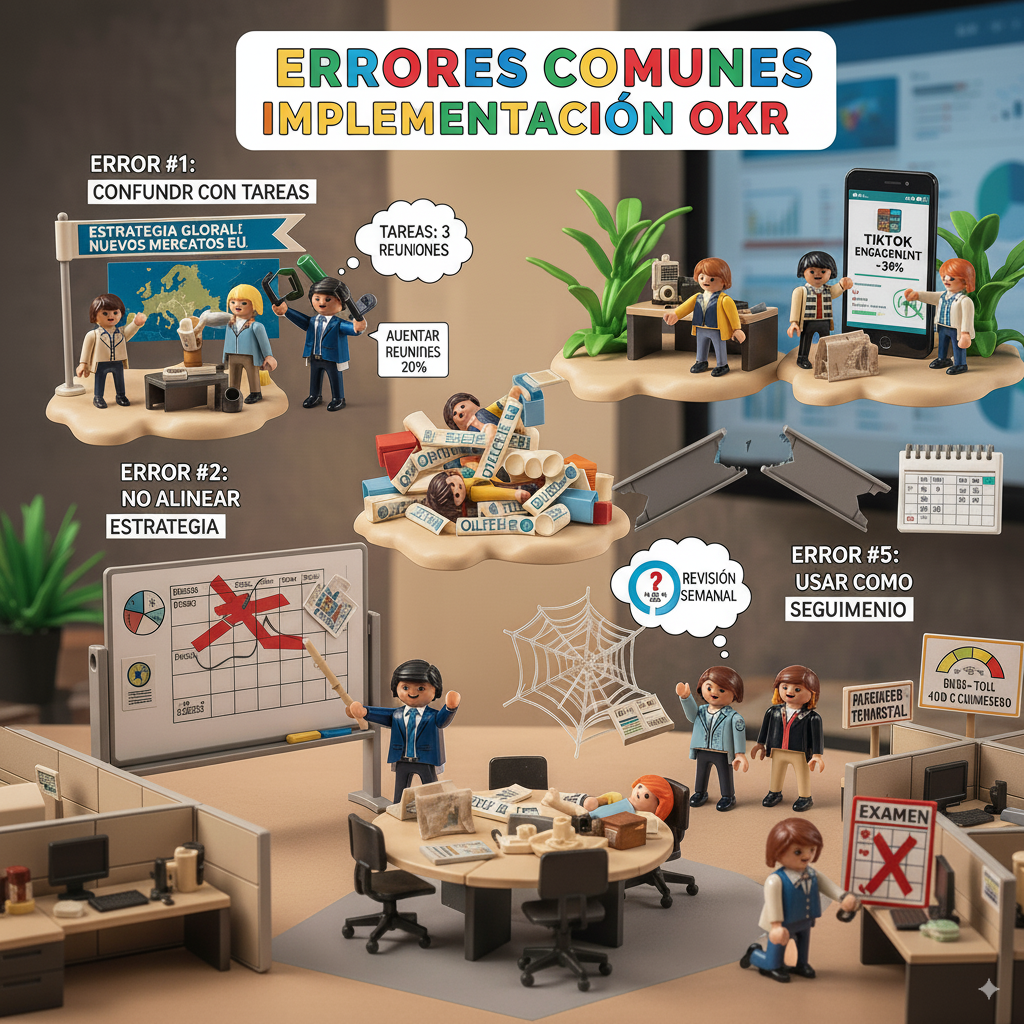
Common Mistakes in OKR Implementation: The Ultimate Guide to Avoiding them
Want to make sure you don’t run into the same common OKR implementation mistakes that frustrate so many companies? OKRs (Objectives and Key Results) are a powerful tool, but if misapplied, they become an exercise in futility.
In this definitive guide, we show you the 5 essential pitfalls to avoid to make your OKRs really work and transform the way your organization works.

What are OKRs and why are they so valuable?
OKRs (Objectives and Key Results) were born at Intel and became known worldwide thanks to Google. They are not a passing fad: thousands of companies use them today because they help connect strategy with the daily actions of the teams. If you want to know all the details, here is the book “Measure what matters” by John Doerr.
Its logic is simple:
Objectives (O) → what we want to achieve (inspiring, challenging, clear).
Key Results (KR) → how we will know if we are going in the right direction (measurable, specific and verifiable).
But beware: if they are applied without understanding the spirit, common OKR implementation errors appear and hinder their potential.
Mistake #1: Confusing OKRs with tasks
Many companies define an OKR as a simple task, killing its true value.
- ❌ Example of an error: “Do three customer meetings every week.” This is a task, not a goal.
- Correct example: “Increase by 20% the number of business meetings held with customers”. Here the impact is measured, not just the action.
Practical tip: Before closing an OKR, ask yourself if it measures an outcome or just describes a step. If it is the latter, it is not an OKR.
Mistake #2: Setting too many objectives
Initial enthusiasm may lead us to fill out a document with 8 or 10 objectives. When EVERYTHING is a priority, nothing is.
The
Scrum Guide
makes it clear: focus is essential. And with OKRs the same is true. We need to focus on a few targets with impact rather than many targets. So the recommendation is:
- Maximum 3 targets (O) per cycle of OKRs.
- Each objective should have a maximum of 2 to 4 key results (KR).
Remember: less is more. Few well-defined objectives generate much more impact than an endless list of unfocused goals.
Mistake #3: Not aligning OKRs with the overall strategy
A critical failure is for teams to define their OKRs in isolation, with no connection to corporate strategy. The result is “islands of work” that do not add up to a common goal.
- Global strategy: Expand into new European markets.
- OKR marketing (misaligned): Increase engagement on TikTok by 30%.
The key question: How does each OKR contribute to the company’s overall strategy? Without that connection, the effort is dispersed.
To understand how to prioritize in line with strategy, check out this article on OKRs.
Mistake #4: Failure to provide continuous follow-up
Defining OKRs and forgetting them until the end of the quarter is like planning a route and not checking the map. A constant OKR follow-up is vital.
- Good monitoring practices:
- Weekly progress reviews.
- Monthly meetings to adjust the course.
- Total transparency: everyone must know the status of the objectives.
OKRs are not a static document, but a dynamic compass that must be constantly reviewed.
Mistake #5: Using OKRs as a punishment tool
Turning OKRs into a quarterly exam kills ambition. Teams will tend to set easy targets just to meet them.
- Right mindset: OKRs should be ambitious and aspirational. Google recommends a 60%-70% completion rate. Meeting 100% of your goals often means you weren’t ambitious enough.
- Rule of thumb: Don’t tie OKRs to bonuses or use them as punishment. Reward learning, not just the result.
Practical tips to avoid mistakes in OKR implementation
- Define impact, not tasks.
- Limit your targets to 3 per cycle and your key results to 3-4 per target.
- Aligns each OKR with the business strategy.
- Make them visible and review them weekly.
- Value the learning as much as the outcome.
How OKRs fit with agility
OKRs work even better when integrated with agile practices:
- In Scrum, they guide the Sprint Goal and help prioritize the backlog.
- In Kanban, key results can be displayed on the board.
- In retrospect, they make it easier to reflect on impact and not just on tasks.
To take it to the field, we recommend you to read our article on agile user storieswhere we explain how to translate big goals into concrete actions.
From mistakes to learning
We’ve all made some of these common common OKR implementation mistakes. The key is to learn fast and adjust course.
A good OKR is not an Excel file forgotten in a folder, but a compass that connects the strategy with the day-to-day.
Remember: the value of OKRs is not in 100% compliance, but in learning, focusing and growing as a team. learning, focusing and growing as a team.
Want more practical ideas to transform the way you work with OKRs and agile methodologies?
Subscribe to our free newsletter
The Smart Drop
and receive clear, applicable and 100% human advice directly in your inbox.