
Distributed Agile Teams: A guide to maintaining focus, energy and confidence.
Ever wondered how to maintain energy and focus when your team doesn’t share an office? Although agile was born for face-to-face collaboration, distributed Agile teams are becoming more and more common.
Far from being an obstacle, they can become a competitive advantage if you take care of communication, rhythm and, above all, confidence. In this practical guide, we show you how to achieve this with tips that can be applied starting tomorrow.

What is a distributed Agile team?
A distributed Agile team is a group of people working from different locations (different cities, countries or time zones) collaborating under agile principles. This means that transparency, communication and coordination depend more than ever on explicit agreements and digital tools.
For example, imagine a team that combines:
- Developers in Bilbo,
- Testers in Mexico City,
- A UX/UI designer in Lisbon,
- A Product Owner in Berlin.
Everyone is working towards a common goal, but they need clear processes to keep pace.
Remote vs. distributed equipment: the difference matters
Although the terms are used interchangeably, there is a key nuance:
- Remote team: Members work outside the office, but are usually in the same city or country, allowing for regular meetings.
- Distributed team: Members are spread across multiple locations and rarely meet physically. This difference conditions the management of agile rituals.
This difference conditions how agile rituals are designed and, above all, how the collective focus is protected.
Challenges facing distributed Agile teams
- Distance brings challenges that must be managed to avoid disconnection:
- Incomplete communication: Nuances are lost in chats, and non-verbal communication (gestures, expressions) becomes almost null.
- Fragile trust: Without face-to-face interactions, it is more difficult to generate the closeness needed to resolve conflicts quickly and build trust.
- Time coordination: Finding a matching schedule for all members is a challenge, especially if they work in different time zones.
- Uneven pace: One team member may be stuck waiting for feedback from another who has not yet started his or her workday.
Keys that make a difference in distributed Agile teams
Distance does not have to be synonymous with disconnection. Just as closeness is not synonymous with connection (both are personal experiences). These practices, which we have tried and tested in real projects, help maintain focus and confidence:
Ritualized communication
- Daily meetings brief and with real focus on impairments.
- Product and workflow dashboards always visible.
- Clear rules for asynchronous communication (e.g., which channel to use for which type of message).
Do it tomorrow: Define which channel to use for which messages and set a maximum response time. If you want to go deeper, check out how to structure the Product Backlog in a clear and shared way: SmartWay VP.
Radical transparency
- Document key decisions in accessible spaces.
- Use visible metrics (burn-down, OKRs, velocity) so that everyone knows where the team stands.
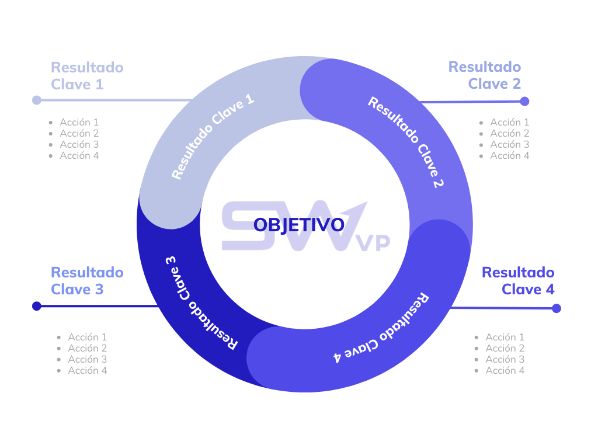
Do it tomorrow: Publish OKRs and graphs on an accessible dashboard. Read how to Implement OKRs in 4 steps. in distributed teams.
3. Spaces for trust
- Periodic 1:1 meetings for individual listening.
- Virtual team building dynamics that break the routine.
- Rotate facilitators in retrospectives to give the whole team a voice.
Do it tomorrow: sets a 20-minute biweekly 1:1 with brief script (accomplishments, blocks, mood).
4. Digital tools that support collaboration
- Communication: Slack, Teams or similar.
- Project management: Jira, Trello or ClickUp.
- Shared documentation: Confluence, Notion or Google Docs.
Do it tomorrow: Review your tools and eliminate duplication.
5. Respect for personal rhythms
- Avoid overloading the agenda with unnecessary meetings.
- Define minimum core hours.
- Promote flexible work arrangements.
Do it tomorrow: block core hours and protect deep workloads.
Best practices for distributed teams
- Visualize the workAnybody should be able to see, at a glance and quickly, where the equipment is at. Do we have any blockages? Does anyone on the team need help?
- Clarifies the Definition of DoneWhen do we close something? Reduce misunderstandings and avoid rework.
- Taking care of Agile ritualsPlanning, reviews and retros as structured as in a face-to-face team. And of course, webcam sessions in order to have the maximum of communication (verbal and non-verbal). Support continuous feedbackBecause improvement is a habit, not an isolated event. This continuous feedback and communication also allows to mitigate and avoid personal conflicts (due to lack of communication).
- Understands the culture of the team: Cultural differences affect how we communicate. Knowing them prevents conflicts and misunderstandings. Take special care to understand the culture of your colleagues. If you want to know more, this book will help you (it helped me)
Scrum and Kanban in a distributed environment
Agile frameworks work perfectly well in distributed environments if properly adapted:
Scrum in distributed
- Daily of 15 minutes maximum, focused on real blockages.
- Sprint reviews open to all stakeholders, even if they are thousands of miles away.
- Immediate feedback documented so that it is not lost in the air.
Kanban in distributed
- Flow visualization becomes even more essential.
- Clear work-in-progress (WIP) limits to avoid bottlenecks.
- Small and frequent deliveries ensure a sustainable rhythm.
In both cases, the reference guide remains the official Scrum Guide. official Scrum Guide.
Case study: A global design team
At the beginning, we have presented the case of a team that:
- Has developers in Bilbo
- Testers in Mexico City
- A UX/UI designer in Lisbon
- Product Owner in Berlin.
With all this in mind, here are some ideas for the team to maintain rhythm, confidence and focus:
- They use collaborative tools such as Miro and shared figma to co-create prototypes collaboratively.
- They have a core schedule of 3 hours where all coincide. They ensure that all time zones coincide at a reasonable time.
- Europe (CET): From 3pm to 6pm
- Europe (UTC): From 12h to 17h – 1h less than Berlin and Bilbo.
- Mexico City: 7h to 10h – 8h less than Berlin and Bilbo.
Note: Yes, you may not always get the best schedule. But you do get an agreed upon schedule so that the team can work together.
- They document all their decisions and actions (both in design, construction and team agreements) and have defined channels for communicating defined channels for communication. Thus, even if they are not on the core schedule, the rest of the people receive the messages and understand what has been done.
- Every Friday, they hold a short retrospective with online online dynamics that take care of motivation. And above all, improve the team’s personal connection.
The result: constant deliveries, real autonomy and a climate of trust that transcends screens.
Conclusion: distance as an opportunity
A distributed Agile team is not a team at a disadvantage, but a team that has learned to work with clarity, trust and collaborative discipline. The distance makes it necessary to make agreements explicit, take care of communication and reinforce the shared purpose.
In a distributed world, agility is not measured in miles, but in shared trust. When this happens, agility unfolds its full power.
If you would like to receive more practical ideas and real cases to transform your teams, subscribe to The Smart Dropour weekly newsletter.