OKRs (Objectives and Key Results) have become the standard for defining strategy and measuring progress. But while defining OKRs is relatively simple, transforming them into aligned execution across teams is much more difficult (unfortunately, there is no formula for it).
This is where the real challenge comes in: how to link strategic objectives to day-to-day work while maintaining visibility across all teams. And while this challenge does not stem from the OKR framework itself, the gap in achieving true alignment with OKR affects many teams.
More often, the real problem is the lack of a good support tool.
Don’t let your efforts go to waste because of poor execution. Choosing a tool that offers visibility, keeps everyone aligned and provides real-time updates is key to succeeding with OKRs.
Even without a “textbook” checklist, OKR alignment becomes much easier when you have the right system behind you.
Let’s explore more.
Why does alignment with OKR matter more than ever?
OKRs are not just another planning exercise that teams conduct at the beginning of each quarter. Their purpose goes beyond writing objectives and describing how to achieve them. The real value of OKRs lies in aligning teams around the company’s priorities and strategic vision.
Achieving true alignment is critical to both team success and strategy execution. According to a recent McKinsey & Company report, team alignment is one of four key factors that influence teamwork effectiveness. And when teams are synchronized and committed to a common goal, they can more easily move toward what needs to be done.
When applied correctly, OKRs improve transparency regarding both long-term objectives and day-to-day work, and help teams prioritize effectively, reducing the risk of misaligned efforts.
Why is it difficult to align OKR in practice (in the absence of a suitable tool)?
Even well-defined OKRs often fail to deliver results because organizations lack the systems needed to support alignment at scale. As a company grows, maintaining alignment becomes a challenge. OKRs run the risk of remaining mere paper statements, rather than becoming actual operational guidance.
Here’s why it becomes difficult without a proper system.
- Strategy and work live in different systems
When OKRs are stored separately from day-to-day work, even the best OKRs create a disconnect between strategic goals and operational tasks. You can define ambitious goals, but not see how teams are executing them.
- The teams work in silos
Different departments may interpret objectives differently. Without a shared system for breaking down OKR, visualizing dependencies and improving collaboration between teams, each area creates its own version of what the organizational priorities are. Over time, this misalignment leads to uneven progress, different value deliverables and conflicting decisions.
- Progress cannot be tracked between levels
Each level of the organization may use different methods to track and measure OKRs. This makes it nearly impossible to understand if key results are on track, detect inefficiencies, or adjust resources and priorities.
The result: more time is spent chasing updates than managing results.
- Responsibility becomes diffuse
When there is no single system that shows who is responsible for what, accountability becomes unclear. Teams may assume that someone else owns a key result and not see how their work contributes or why it is important.
- Lack of real-time information
Strategy is not static: it evolves, and so do team capacity and priorities. But without a real-time view of progress, bottlenecks or workload, organizations can’t make informed decisions, identify problems or take advantage of opportunities for improvement. Review your OKRs periodically and adapt them as needed.
What changes when you introduce the right tool
Incorporating a dedicated tool to support OKR alignment is not about adding more processes. It is about making the alignment process easier, transparent and sustainable.
That’s how the right platform transforms everything.
- The strategy becomes a living system
You can update objectives, track progress and adjust priorities in real time. Everyone sees the same definitions, metrics and goals.
- The work is directly connected to the objectives
Modern platforms allow you to map objectives to initiatives, projects and tasks. This gives you a clear view of which activities contribute to strategic success and which do not.
- Transparency and alignment between teams are strengthened
When multiple teams work in overlapping OKRs or with dependencies, miscommunication is almost inevitable. With the right platform, teams no longer feel disconnected. Communication flows without friction and decisions are made based on shared context, not assumptions.
- Real-time progress tracking becomes possible
Instead of collecting data manually, modern OKR solutions give you instant feedback on what is blocked or delayed, show clear trends in progress and provide early warnings before problems escalate.
From strategy to execution: how does it work in practice?
So far, we have clarified the importance of alignment for OKR success and why investing in a tool is non-negotiable.
This is what the process looks like in practice. As an illustration, we will use Businessmap as an example.
1. Visualize your strategic objectives
The first step is to define your strategic objectives – your “north star”. In general, you can use any tool to do this: whiteboards, kanban boards, canvas, etc.
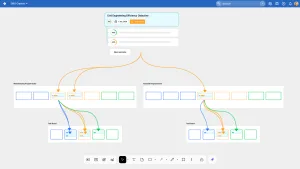
At Businessmap, we use Smart Canvas to visualize our high-level business objectives. From there, you can map the entire process all the way down to the team level, thus getting the full picture.
2. Break down the objectives into team initiatives
Using a portfolio management dashboard allows leaders to structure and connect company and team OKRs into a single dashboard.
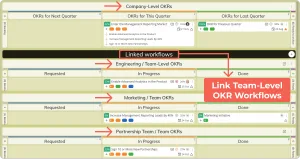
3. Manage OKRs at the team level.
Later in the process, each team has the autonomy to define its own objectives and break down the initiatives into tasks and deliverables to reach the goal. Many teams use kanban boards to visualize and track work progress.
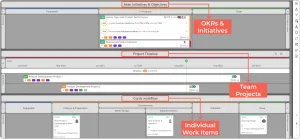
4. Track OKR progress
The integrated tracking functions allow you to monitor the status of each key result and see how close you are to your goals. In Businessmap, the “measurable result” is integrated within an initiative-type work element.
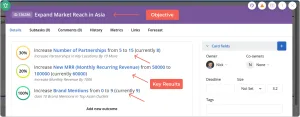
Thanks to this connected system, everyone has access to the latest updates and information on OKR progress. This transparency helps leaders stay fully informed and maintain a clear, high-level view of what is happening throughout the organization.
The Real Life Test
One of our clients – a Fortune 500 energy company – was facing serious alignment and visibility issues across its vast network of departments. Their main challenges included limited visibility into work in progress, leadership difficulties in understanding how teams were contributing to strategic OKRs, and hundreds of hours of wasted effort due to outdated initiatives.
To address these challenges, the company introduced Businessmap’s Businessmap’s centralized digital management dashboardwhich visualized strategic OKRs and created clear workflows for prioritization, drill-down and alignment across departments. Each strategic OKR progressed through structured stages, while all workflows were connected to ensure real-time visibility.
This unique alignment structure allowed departments to execute OKRs while leadership was kept informed on an ongoing basis.
The result was an impressive 80% increase in visibility of the strategy and on strategy and work activities, more than 100 hours saved 100 hours saved through faster communication of priorities, and compelling evidence that OKR alignment, combined with the right tool, delivers measurable results.
Want to start transforming with OKRs and businessmap? Start here.