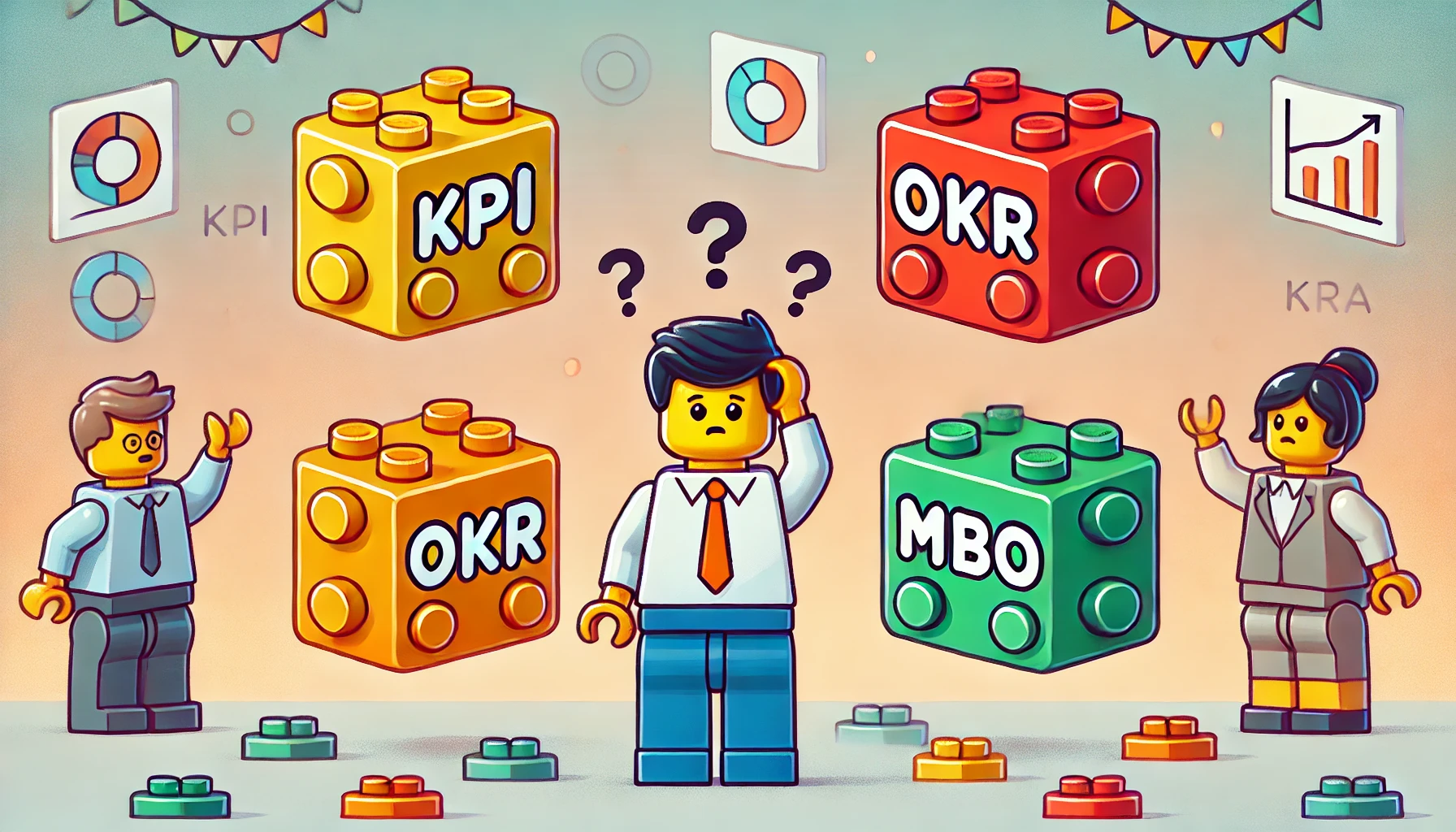
Have you ever heard terms like KPI, OKR or MBO and felt lost? Don’t worry, you’re not the only one. It’s normal that so many technical acronyms can seem like a maze, especially when it’s not clear which one to use or why they are important.
KPIs are key indicators to evaluate whether things are being done well. But how are they different from other indicators?
What is a KPI and what is its importance?
Imagine you’re managing a sales team and you’re told that profits are up. Good news, right? But what if you don’t know how much they grew, in what region or thanks to what strategy? Without clear data, it would be like driving a car without knowing the direction.

A KPI, or key performance indicator, apart from being just another number in your spreadsheet or presentations, is the data that really matters, as it tells you whether or not you are making progress towards your objectives.
Difference between metrics and KPI
Are a metric and a KPI the same thing? There is a tendency to confuse these two terms. But imagine, for example, that metrics are like your vacation photos: they show everything that happened. KPIs, on the other hand, are those few photos that you select because they tell your story best.
Think about this: if you have an online store, one metric might be how many people visit your website. But a KPI would be something more useful, like the percentage of visitors who end up buying. That’s the difference. Metrics show you what’s going on, while KPIs guide you to achieve your goals. Every KPI is a metric, as in the example of photos, whereas not every metric would tell a story.
Main characteristics of a KPI
A good indicator must not only measure results, but do so in a strategic and effective way, they must focus on action. To achieve this, they must not only be related to business objectives, but also have SMART characteristics. These characteristics ensure that your indicators are useful, actionable and focused on the most relevant objectives.
These are the SMART characteristics that define a good KPI:
- Specific: They have to be super clear. No ambiguous terms; they must focus on something concrete so that everyone understands what is being measured.
Example: Instead of measuring something general like sales, you could measure the number of premium products sold per month. - Measurable: If you can’t measure it, you can’t manage it. A good KPI should generate clear and objective data that you can easily track.
Example: Conversion rate of web visitors to customers is a measurable indicator because it can be calculated with analytical tools such as Google Analytics. - Achievable: It’s great to be ambitious, but they also need to be realistic. If the indicator evaluates something outside the current scope, it can generate frustration or unhelpful data; if it measures something too simple, it loses relevance as an analysis tool.
Example: If you historically answer 70% of support tickets within 24 hours, an achievable indicator would be percentage of tickets resolved in less than 24 hours. - Relevant: An indicator is only useful if it is aligned with your business objectives, otherwise it will be just another metric. Don’t waste time measuring things that don’t contribute to the bottom line.
Example: If your goal is to improve customer experience, you could measure customer satisfaction (CSAT) and not something less related such as number of visitors to the website. - Time-bound: They need a time limit so that you can measure progress in a concrete way. Without a deadline, it is difficult to know if you are on track or if you need to adjust something.
Example: A metric could be the number of projects completed on a quarterly basis, where there may be projects that last longer than that. However it could be rephrased as the number of features delivered to the customer in that same time.
KPI vs OKR: what is the difference?
And OKRs, aren’t they the same thing? Although both are super complementary tools, they serve very different functions. In fact, while KPIs are performance metrics, OKRs are not metrics, although they may appear to be, but are used to set and achieve ambitious goals.
What is an OKR?
An OKR, short for Objectives and Key Results, is a framework that sets goals (something ambitious you want to achieve) to achieve alignment and focus, and uses key results as indicators to tell you if you are making progress toward that goal. OKRs not only measure progress, but also push you out of your comfort zone.

If you want to learn more about OKRs you can learn more in the following article https://smartway.es/introduccion-okr/, and become a master in one of our courses https://smartway.es/okr-master/.
An example of OKR could be:
Objective: To be recognized for offering the best customer service in our industry.
Key results:
- Raise our customer satisfaction score (CSAT) to 95%.
- Reduce complaints by 40% in the next 6 months.
OKR vs KPI: what are the differences?
Reading the above definition you can intuit the differences between KPI and OKR, that while KPIs are metrics that help you measure how performance is currently going, OKRs are more oriented to set ambitious strategic objectives to move towards the future, aligning everyone in the same direction.
Although there are differences between the two, there is no question of choosing one or the other. In fact, they are at their most powerful when combined.
Combining OKR and KPIs to enhance your strategy
KPI and OKR are totally complementary, and the ideal is to use them together so that, while monitoring the current status, you can make strategic decisions for the future.
- Use KPIs as a basis for your OKRs
- Look at the KPIs you are already monitoring (such as conversion rate or customer response time).
- Identify which KPIs can help you achieve a powerful objective. Use these KPIs as the basis for Key Results in your OKRs.
- Monitor KPIs during OKR cycle
- Establish regular reviews (weekly or monthly) to monitor KPIs related to your OKRs.
- Adjust strategies or tactics if you notice that an important KPI is not improving.
- Balances operations and transformation
- Use KPIs to make sure everything is under control (sales, costs, satisfaction).
- OKRs should focus on more ambitious and transformative goals.
- If an important KPI is not doing as well as it should, make it a key objective within your OKRs.
- Prioritize what really matters
- Divide your KPIs into two groups: those you only need to monitor and those that really make a difference.
- Make the KPIs that have the greatest impact on results become the Key Results of your OKRs.
- Continually evaluates and adjusts
- At the end of a quarter or OKR cycle, review how the associated KPIs have changed.
- Again, if a critical KPI did not improve sufficiently, consider including it in the next OKR cycle.
Other success measurement tools
Apart from those mentioned above, there are more acronyms that are used in companies, albeit to a lesser extent, such as KRAs and MBOs. They are not metrics per se.
What are KRAs and how do they relate to KPIs?
KRAs, or Key Result Areas, are the areas within a company where you need to see results. They are not metrics, but those key areas that define where to concentrate efforts. For example, if you work in sales, a KRA could be to increase strategic customer acquisition, or in marketing, to position the brand in new markets.
The KRAs do not include concrete measurements or metrics, but if you use the KPIs within each KRA you will be able to measure whether you are meeting those key areas. So, while the KRAs tell you what to achieve, the KPIs tell you how you are doing and whether you are succeeding. After this definition, are you familiar with how these KPIs and OKRs were combined? An example for the Customer Experience area:
- KRA: Improve the customer experience. This establishes the key area of focus: ensuring that customer interactions are smooth, satisfying and aligned with expectations.
- KPIs: These are the various key indicators that indicate the performance of the KRA:
- Customer Satisfaction Score (NPS).
- Average time of resolution of consultations (ART).
- First contact resolution rate (FCR)
Difference between KRA and OKR
If a more ambitious approach is added to the KRAs, we could turn it into OKRs. Unless the area in question was key to the strategy, it would rarely be first level OKRs, these OKRs that guide the organization, but we would go to a second level, how does a specific area collaborate with the company’s objectives? Remember that OKRs are not hierarchical, therefore, it is not recommended to have more than two levels, as the first level OKRs would be diluted.
The above example could be converted to an OKR as follows:
- Objective: Significantly improve the customer experience.
- Key results:
- Increase NPS from 7.5 to 8.5 in the next quarter.
- Reduce the Average Resolution Time (ART) from 4 hours to 2 hours.
- Achieve a first contact resolution rate of 90%.
And to measure progress towards the objectives using the Key Results, the key indicators defined for each KRA can be used, as we saw for the OKRs.
What are MBOs and how are they used in companies?
MBOs, or Management by Objectives, can be considered the parents of OKRs. They were introduced by Peter Drucker in the 1950s, and the goal was to let employees know how their efforts contributed to the organization’s strategy through clear objectives designed by the teams.
MBOs are also not metrics, just as OKRs were not, although by the same token, you will need key metrics to know progress, and this is where KPIs come into play, as they provide an objective and quantifiable way to measure progress towards MBOs.
The big difference with OKRs, which Andy Grove pioneered with his work at Intel in the 1970s, is that they are focused on longer cycles, so they are more static, and also do not have key results associated with them.
Although OKRs have burst onto the scene, MBOs are still useful today for more stable environments.
Tips for defining good KPIs
Designing and choosing key indicators seems trivial, until you get down to it. That’s why it’s key to keep certain considerations in mind:
- Align them with strategic objectives: They should be used to measure important things for the organization, such as improving the customer experience or working faster and better.
- Involve everyone: The teams that will work with them should help define them. This will make them clearer for everyone, and above all more useful.
- Measure what matters: Focus on metrics that really help you make decisions, not on numbers for the sake of measuring something.
- Less is more: You don’t need a thousand metrics. Rather choose a few that are key.
- Don’t be afraid to change: They are not static. Evaluate if they are still relevant and make adjustments if necessary.
- Be transparent: Share results with everyone. This helps to learn and keep efforts aligned.
- Combine real data with perceptions: Mix concrete numbers (such as times or rates) with opinions or qualitative feedback, e.g. from customers.
- Beware of metrics that create bad habits: Some poorly stated metrics can cause the team to focus on the wrong things.

Finally, a very relevant example of this last tip, and one that occurs in many companies, is for example to measure the team’s delivery speed. This KPI could lead the team to prioritize easy tasks that bring less value to the business. By turning it around a bit, we could instead measure the value provided per iteration (% adoption, NPS or similar), which could put the focus on the speed of delivery, on the prioritization of the backlog, or even on product discovery.