

OKRs with AI: Is it possible? How to use artificial intelligence to define strategic objectives
What if your AI could design your team’s OKRs? Sounds tempting, but beware: without strategic filters, you run the risk of being left with empty targets and vanity metrics.
When we talk about training an AI model, the conversation usually revolves around data, algorithms and tools. But experience teaches us something crucial: it is not the tool that makes the difference, but the strategy that supports it..
As is the case with the implementation of OKRs In agile teams, training an AI model without a clear purpose is like rowing a boat with no direction. You can move forward, yes, but you will hardly reach a successful conclusion.
In this article we will explore how to connect OKRs with AI to ensure that your model doesn’t get trapped by vanity metrics and has sanity checks to reinforce the strategy. We begin.
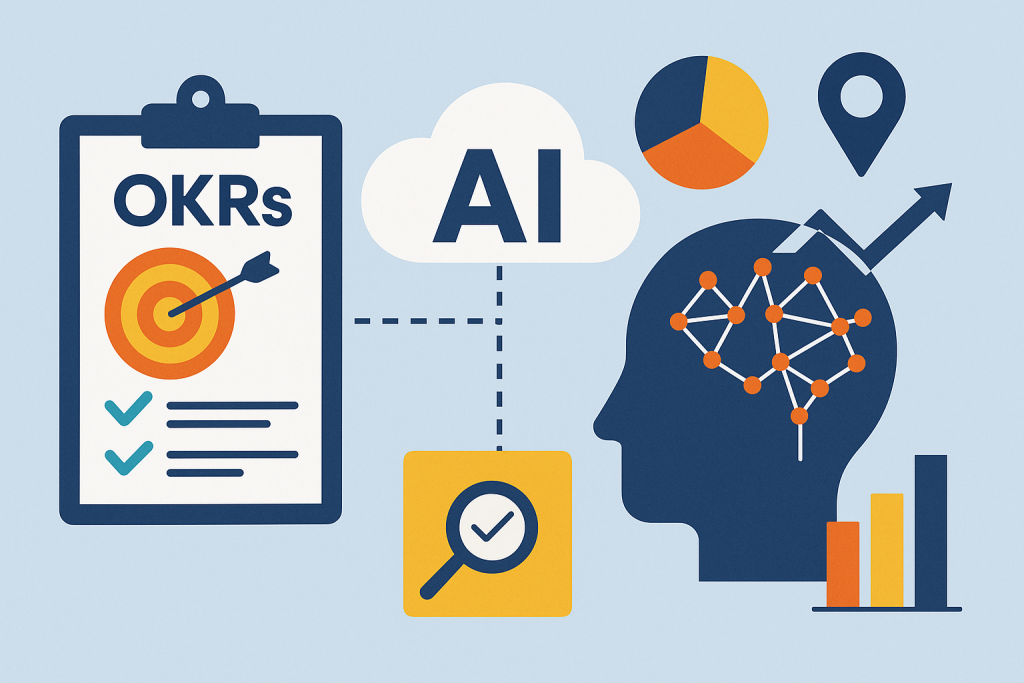
How to create OKRs with AI?
The OKRs (Objectives and Key Results)OKRs (Objectives and Key Results), a management by objectives system born in the 70’s at Intel and popularized by Google since 1999, align teams around ambitious and measurable objectives. ambitious and measurable objectives.
Where does AI come into all this? In two moments:
- Initial design: Suggest objectives and key results (KRs) based on your strategy, reports and data.
- Refinement: Detects whether each KR is measurable, realistic and connected to business impact.
If you need a quick primer on OKRs, check out this article Implement OKRs in 4 steps in your teams. There we explain how to structure OKRs in an easy and fast way in the teams.
How can AI help you focus your OKRs?
Used judiciously, AI acts as a strategic co-pilot. strategic co-pilot. Some specific uses:
- Propose inspiring objectives: AI can analyze strategic documents to suggest objectives that align with the company’s vision.
- Rephrase fuzzy KRs: You can transform abstract phrases such as “improve communication” into measurable KRs such as “increase participation in weekly meetings by 20%”.
- Prioritize relevant metrics: By analyzing your data, AI can help you identify which metrics actually provide value and discard vanity metrics.
- Validate feasibility: With access to historical data, AI can validate whether an objective is achievable within a defined time frame and justify its step-by-step reasoning.
- Automate validations (sanity checks): AI can automatically verify that each KR meets the requirements of a good objective, such as strategic alignment, measurability and feasibility.
The key is that AI does not replace human reflection, but rather accelerates the design process and reduces the bias of poorly validated “occurrences”.
Vanity metrics vs. sanity checks: the essential filter
One of the biggest risks when defining OKRs with AI is to end up with metrics that look good in a report, but have no real business impact. To avoid this, you need to implement sanity checks.
A sanity check is a simple validation that ensures that your objective or metric makes sense in the strategic context. Your sanity checks should consider:
- Strategic relevance → check that the objective or KR is aligned with the mission or priorities of the business.
- Objective measurability → ensure that the key result can be quantified with clear and verifiable data.
- Realistic feasibility → validate that, although ambitious, the objective is achievable within the defined time frame (usually one quarter).
Examples of sanity checks useful:
- Is each OKR connected to a real strategic impact (such as sales, retention or customer satisfaction)?
- Is the indicator measurable with reliable data and without relying on subjective perceptions?
- Is the level of ambition high but achievable in the defined period (e.g. one quarter)?
If you want to dive deeper into measuring what matters, stop by. OKRs for Agile Transformation and remember that inspection and adaptation are core principles in the official Scrum Guide.
How to train your AI to create useful OKRs
Training an AI to assist you in creating OKRs is not about reprogramming complex models. It is about show you with examples and validations what you want to achieve.
- Define a base dataset: Gather examples of well-written OKRs from your organization or success stories. Show the AI what you expect.
- Sample Prompt: “Learn the style of these OKRs. Point out the pattern of wording and structure. Don’t generate anything, just summarize patterns.”
- Adjust the prompt with context: Give the AI information about your industry, business model and constraints. Ask it to structure OKRs as “Inspirational goal + 3 key measurable and strategic outcomes”.
- Example Prompt: “We are a B2B SaaS scale-up. Generate 1 objective and 3 measurable KRs for the Customer Success team. Use the learned model.”
- Introduce sanity checks in the instruction: Ask the AI to self-validate each KR with questions such as “is it measurable?” or “is it connected to a real strategic impact?”.
- Sample Prompt: “For each KR, add a sanity check validation: (1) strategic alignment, (2) measurability with data source, and (3) quarterly feasibility. If it fails, reformulate.”
- Itera with human feedback: Correct and feed back to the model with your knowledge of the industry. The AI is a co-pilot; you provide the knowledge of the organization.
As in product backlog managementthe key is to continually prioritize and refine.
Practical example: OKRs with AI for Customer Success
Imagine a scale-up B2B SaaS with offices in Madrid and Berlin offering an analytics platform for retail companies. The business is growing fast and already manages more than 500 accounts in Europe.
In the last quarter, the Customer Success team detected a serious problem in the mid-market segment: the churn rate was increasing 15% more than in other segments. In analyzing it, they saw that:
The NPS (Net Promoter Score) remained low (36 points).
The mean time to resolution (MTTR) in support exceeded 40 hours, generating frustration.
The first contact resolution (FCR) rate was very low, which multiplied the number of open tickets.
To solve the situation, the team decided to rely on AI, training the OKRs AI model with historical data from Zendesk, CRM and customer surveys. The result, here:
- Objective (O): Increase customer satisfaction and loyalty in the mid-market segment during Q1.
- Key Results (KRs):
- KR1: Increase NPS by +8 points (from 36 to 44).
- KR2: Reduce TMR from 42 hours to 24 hours.
- KR3: Achieve 85% FCR (first contact resolution).
Automatic AI sanity checks (post-training):
Alignment (✔️): Both NPS and FCR are directly connected to retention and, therefore, to revenue.
Measurability(✔️): Indicators come from reliable sources: NPS surveys, Zendesk and CRM.
Viability(✔️): History suggests that improving between +6 and +9 NPS points in a quarter is feasible.
Vanity metric discarded (✖️): “number of chatbot responses” (does not measure real impact on satisfaction or retention).
This example demonstrates how AI for OKRs can transform scattered data into a real and tangible strategic focus, enabling a team to move from reaction to action.
Strategy over the tool
Using AI to define OKRs is not the future: it is present. Train it with examples, demand sanity checksavoids vanity metrics and aligns each KR with real impact. The tool accelerates; the strategy decides.
Remember: the AI is a co-pilot, not the pilot..
Join The Smart Drop and receive practical guides like this one every week.