Scrum vs Kanban vs SAFe: which Agile framework is better for you?
12/06/25
Spoiler alert: the short answer is “it depends”… and the long one too.
“Scrum vs Kanban vs SAFe“: if you’ve Googled this phrase, you’re not alone. This is one of the most common doubts when an organization decides to make the leap to agile.
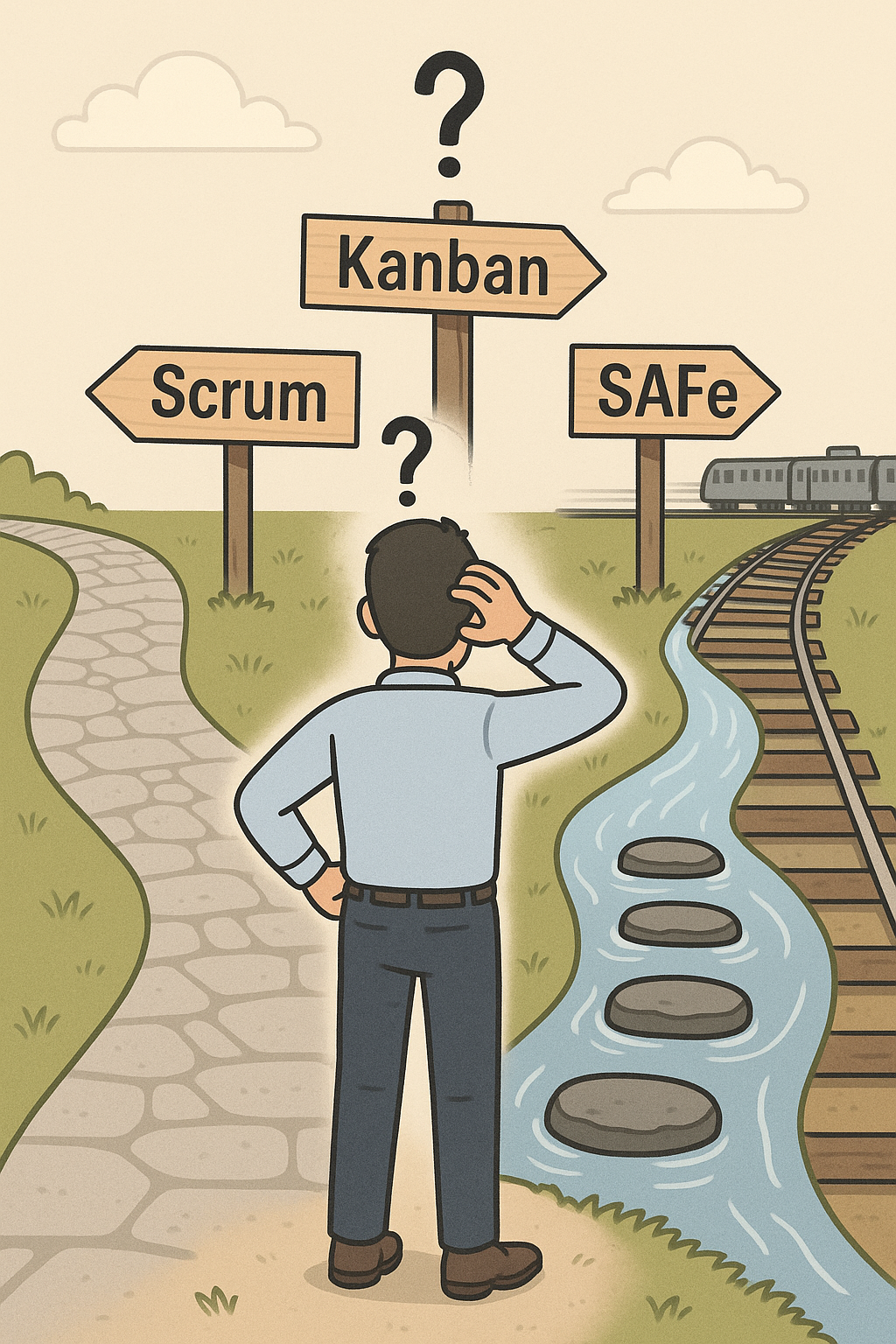
Are you trying to become more Agile and don’t know whether to choose Scrum, Kanban or jump into the SAFe pool?
If you are an expert in Agile methodologies or organizational transformation, you may not learn much, but if you are thinking of changing, improving or evolving your team, department or organization, at the end of this article you will have the tools to know which one is best suited to you (and your team, this is not about lone heroes).
In case you need support, in our Agile consulting we help you make strategic decisions about which framework to apply according to the reality of each team.
Let’s get down to business!
Why on earth are there so many Agile frameworks?
Before you start hyperventilating with weird names like LeSS, Nexus or Spotify Model, let’s focus on the three most asked about in organizations today: Scrum vs Kanban vs SAFe.
Scrum vs Kanban vs SAFe
These three frameworks have in common that they seek:
Iteratively deliver value
Adapting to change
Continuous improvement
They seem like three simple characteristics, but each one holds much more than meets the eye. For example, delivering value… how do you measure value in your team or organization?
But let’s get back to the topic I digress!
These three Agile methodologies are not the same, nor do they serve the same purpose. So let’s take them apart one by one, to see which one suits you best according to your “level of organizational chaos”.
What is Scrum?
Scrum is, without a doubt, the most well-known Agile framework… and also one of the most misunderstood. If you are looking for a comparison of Agile frameworks such as Scrum vs Kanban vs SAFe, getting a good understanding of what Scrum offers is key to making an informed decision.
Born in the 1990s, it is inspired by iterative work models such as those of Toyota or software development. Although its premise is simple – work in short cycles to deliver value frequently – its execution requires commitment, clarity and team maturity.
Scrum is not just about post-its and meetings
Scrum is a structured framework, ideal for teams of 5 to 10 people working in cycles called Sprints. Each Sprint lasts between 1 and 4 weeks, and at the end something functional and reviewable is delivered.
In our Agile consulting, we find that Scrum is especially useful for teams that need structure, focus and continuous improvement without losing agility.
Key roles:
Product Owner (PO): maximizes the value of the product.
Scrum Master (SM): facilitates the framework and removes impediments.
Development Team: builds the product collaboratively.
Events:
Sprint Planning
Daily Scrum
Sprint Review
Sprint Retrospective
Artifacts:
Product Backlog
Sprint Backlog
Increment
When to use Scrum?
Scrum is especially useful if:
Your team works with constant uncertainty.
You need to deliver value on a frequent basis.
You are looking for a stable rhythm and a clear framework for improvement.
In addition, it fits very well in organizations that are beginning their transition to a more mature Agile culture, such as those we accompany in organizational transformation processes.
Advantages of Scrum
It provides a clear structure without excessive stiffness.
Encourages continuous improvement as part of day-to-day business.
Increases transparency and inspection in short cycles.
Helps create a strong team culture, with defined roles and objectives.
Disadvantages (yes, there are disadvantages)
It may be too rigid for creative or very autonomous teams.
If misapplied, it becomes an empty ceremony.
It doesn’t scale well on its own (that’s where SAFe comes in).
It requires the team to have a certain maturity and commitment.
Scrum in Masterchef
Scrum explained with MasterChef
Imagine a cooking team in MasterChef. Each week (Sprint) they have a specific challenge (Increment), roles are distributed (lead chef, sous chef, cooks), they have limited time and at the end they present the finished dish to the jury (Stakeholders).
Then they look back: What worked? What can be improved? And the next day, another challenge. That’s how Scrum works: with focus, pace, continuous delivery, and room to learn.
What is Kanban?
If Scrum seemed structured to you, Kanban is the opposite: it is the most fluid, evolving and adaptable option among the frameworks we compare in this scrum vs kanban vs safe guide.
In fact, more than a methodology, Kanban is a philosophy of continuous improvement. It was born in Japanese manufacturing (yes, Toyota again), but has become a key tool for knowledge work environments.
What does Kanban propose?
Instead of imposing abrupt changes, Kanban helps you improve what you already do. It is ideal if your team already has a process and wants to optimize it without trauma.
Its key principles:
Visualize the workflow: use a dashboard where you can see the status of each task.
Limits work in progress (WIP): prevents overloading.
Manage and improve flow: measure how long it takes to deliver and find bottlenecks.
Make policies explicit: everyone must understand how it works.
Continuous feedback: constant review and improvement.
Collaborative and evolutionary improvement: change little by little and with consensus.
In our organizational consulting, we use Kanban for teams that need visibility, efficiency and frictionless change.
When to use Kanban?
Kanban is perfect if:
You work in environments with unpredictable tasks (support, customer service, maintenance).
You already have a functional process but want to optimize it.
You can’t (or don’t want to) implement a structural change like Scrum.
Kanban does not tell you “what to do”, but “how to improve what you do”.
Advantages of Kanban
Ultra flexible, it adapts to any equipment or environment.
It does not require new roles or mandatory events.
Easy to implement progressively.
Ideal to start with if your organization is not ready for a big change.
Reinforces continuous delivery and visual approach to work.
Disadvantages of Kanban
Without discipline, it can become chaotic.
It does not impose objectives or rhythm, which can generate dispersion.
It may lack focus if there is no clear vision of the objective.
A priori, it does not define roles or ceremonies, which may confuse new teams.
Scaling it up is difficult if there is no shared culture of improvement.
Kanban in kitchen
Kanban explained with a kitchen
Imagine a fast food kitchen. Orders come in and are placed on a board. Each cook takes one based on availability. If there are too many open orders, the flow gets clogged. Therefore, the WIP is limited so that the dishes go out at a good pace.
There are no sprints, no synchronized deliveries. The goal is a constant flow, with no bottlenecks.
If you are looking to choose an Agile methodology without major internal revolutions, Kanban is probably your best starting point.
What is SAFe?
SAFe: scaling agile to the organizational level
After comparing Scrum and Kanban, we enter the third key component of this agile framework comparison: SAFe (Scaled Agile Framework). If you’ve come this far thinking that none of the above fit you at all, this may be the missing piece.
What problem does SAFe solve?
Basically: how do you do Agile when you have 20 teams working on related products?
SAFe was created precisely to respond to this complexity. It is a framework that allows coordinating multiple Agile teams without losing focus or strategic coherence.
Program level: coordination between several teams (Agile Release Train).
Portfolio level: initiatives are aligned with the global strategy.
(Optional) Large Solution level: for complex solutions with multiple ARTs.
Key roles:
Release Train Engineer (RTE)
Product Manager
System Architect
Business Owners
Relevant ceremonies:
PI Planning: quarterly planning with all teams.
System Demo: integrated value demonstration.
Inspect & Adapt: global retrospective.
For example, imagine a telecommunications company with 20 technical teams working on the same digital solution, from different countries. If there is no coordination, there is chaos. SAFe comes to bring order to that chaos.
Advantages of SAFe
SAFe presents a series of very interesting advantages for its “adoption”:
It allows Agile to scale without losing the strategic north.
Promotes alignment between business and technology.
Establish clear planning, delivery and inspection schedules.
Integrates Agile, Lean and DevOps principles.
Facilitates governance without killing agility.
But… Is it for everyone? SAFe is not a framework for starting from scratch. It requires a minimum of organizational maturity and, above all, committed leadership.
Disadvantages of SAFe
It can feel “corporate” and bureaucratic if applied mechanically.
Requires training and understanding of the system.
It can kill Agile spontaneity if it becomes dogma.
It takes time and effort to mature and consolidate.
For this reason, when we accompany large companies from our Agile consulting, we always start by evaluating whether SAFe is a real need… or a symptom of wanting to “organize the chaos” without resolving the structural issues.
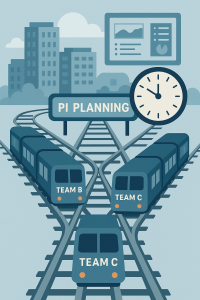
SAFe Trains Example
How do you know if SAFe is for you?
Imagine a large technology company or telco with teams spread across several countries, all working on the same digital solution. Without coordination, there is chaos. SAFe is that railway system that organizes trains so that they arrive on time and do not collide.
Scrum vs Kanban vs SAFe: how to choose?
Here comes the heart of the article and I would like to provide you with a table, as an initial checklist that can help you direct your decision.
Key question
Scrum
Kanban
SAFe
Do you have a small, autonomous team?
✅ Yes
✅ Yes
❌ No
Do you have unpredictable and non-repetitive tasks?
⚠️ Not ideal
✅ Yes
⚠️ Depends
Do you need focus, pace and continuous improvement?
✅ Yes
⚠️ Depends
✅ Yes
Do you need to align the work of more than 20 people towards a common goal?
❌ No
⚠️ Difficult
✅ Yes
Does your company already have 5+ Agile teams?
❌ No
⚠️ Difficult
✅ Yes
Do you want to start with something simple?
✅ Yes
✅ Yes
❌ No
Rule of thumb:Start with what best fits your current context, not what sounds prettiest on LinkedIn.
What if you combine several Agile frameworks?
Scrum vs Kanban vs SAFe
A common doubt in any process of choosing Agile methodology is: Can I use Scrum in some teams, Kanban in others and have SAFe as a strategic umbrella?
The answer is clear: yes, you can. And not only can you: many mature organizations already do.
We have worked with companies that use:
Scrum for development teams
Kanban for operational flows or support areas
SAFe as a cross-cutting coordination framework
The important thing is not methodological purity, but rather that each team or area uses the framework that best adapts to its reality, in a way that is coherent with the global vision.
However, beware of ending up with a nimble Frankenstein.
Combining frameworks without reflection can result in an incoherent and frustrating system, where no one understands how to work, each team goes it alone, and chaos grows rather than diminishes.
The key is to understand the purpose of each methodology, and use them as complementary, not competing, tools.
What if the problem is not the frame?
Now that you have a clear picture of Scrum vs Kanban vs SAFe, I throw the awkward question at you:
What if the problem is not the framework, but how you apply it?
No single framework is going to fix a toxic culture, absent leadership or lack of purpose. The introduction of these methodologies entails change, and all change requires management, accompaniment and consistency.
We see it all the time in Agile transformation processes: it’s not just about choosing a framework, but preparing the culture and teams to make it work.
What do you need to have before choosing a frame?
Teams with shared purpose and real autonomy
Leadership that empowers and not just supervises
Real spaces for continuous improvement
Feedback and learning culture
Without these ingredients, any methodology you choose will be like putting new tires on a car without an engine.
As a final test
This is not a scientific test, but it can help you choose where to start. I won’t tell you exactly which frame to use, but which one you should explore first.
Is your team new to Agile?
Are you eager to improve the way you work? → Start with Scrum
Does your team have a hard time adapting to change? → Also Scrum, with structure and accompaniment.
Do you have a constant flow of tasks without clear dates? → Try Kanban
Are you a large organization and need to coordinate multiple teams? → Explore SAFe
And remember: no frame is magic. But they can all add value if applied with common sense, aligned with your objectives and culture.
In our Agile consulting, we work so that the decision is not a blind bet, but an informed and sustainable choice.
Final thought: Scrum, Kanban or SAFe are not religions.
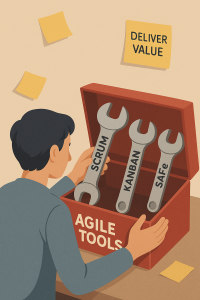
Scrum, Kanban or SAFe are not dogmas or closed systems. They are tools. And like any tool, what makes the difference is knowing when, how and what to use them for.
Don’t be obsessed with methodological perfection.
Focus on what is important:
Deliver value
Listening to the customer
Continuous improvement
Caring for the team
Fast learning
Did this article help you to see your Agile path more clearly? If you are in the middle of a transformation, or you need support to make the right choice -and not die trying-, we are here to help you. Learn how we work in Agile consulting at SmartWay