
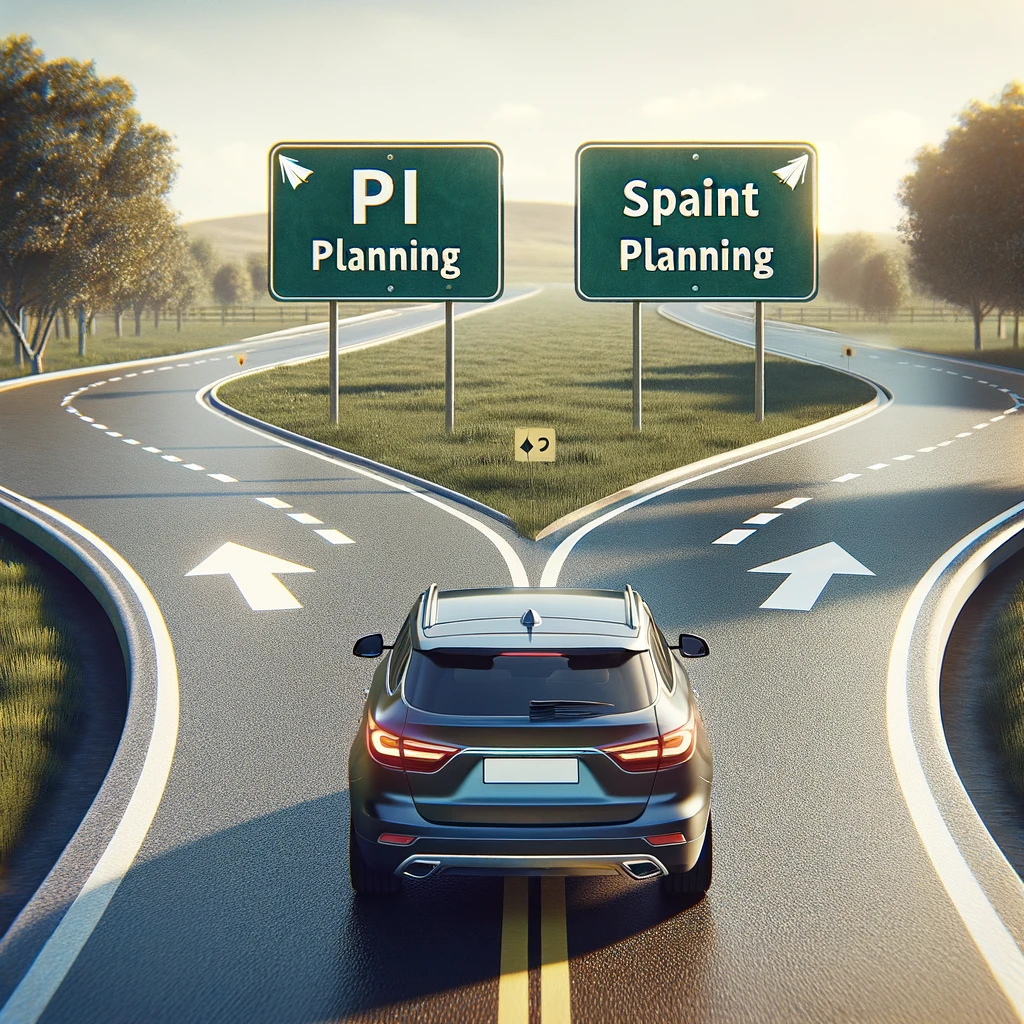
Good planning is fundamental for success.
Many people think that in agile there is no planning, which is categorically false: there is no long-term planning in detail (as for example the famous Gantt Diagrams do, which are almost never fulfilled), but there is detailed planning in the short and medium term, and high level planning in the long term with Roadmaps.
This article breaks down in detail the functions, similarities and differences between PI Planning and Sprint Planning.
Understanding PI Planning and Sprint Planning
Let’s explore what both events are and how they work.
What is PI Planning?
PI Planning is a cornerstone of the Scaled Agile Framework (SAFe).
It is a planning event that brings together for two full days all the members of all the teams that make up a train (Agile Release Train, also known by its acronym: ART).
It serves to align objectives and plan your deliverables for the next Program Increment, i.e. for the next 8 to 12 weeks. This event is crucial to ensure that all teams are aligned and synchronized.

Sprint Planning Fundamentals
The Sprint Planning is one of the 4 ceremonies or key events in the Scrum methodology, the most used and known by far of those that are part of the Agile mindset. This event marks the beginning of each sprint, which typically lasts between two and four weeks.
During Sprint Planning, the development team, together with the Product Owner and the Scrum Master (as “facilitator”), selects the user stories or Product Backlog items that they commit as a team to complete during the sprint.
In the Sprint Planning the team must clearly state the sprint objective and a plan to achieve it. As a good practice, first the Sprint Objective would be defined and then the PBI (Product Backlog Item) would be selected to achieve that objective a priori.
Duration and Cycles in Agile Sprints
The choice of sprint duration in Agile has a big influence on how the team will work.
The goal is to choose the shortest possible duration, because this allows teams to adapt quickly to changing customer needs, while maintaining focus on frequent value creation. However, too short a duration forces the team to be able to “break” or break down the user stories into smaller stories that are still small but provide value in their own right and are a real deliverable that can be shown for feedback at the Sprint Review. This breakdown of stories into smaller ones is not always easy or even feasible, which is why the shortest Sprint duration is not always chosen. It can also happen that in “too short” Sprints the team does not have the capacity to deliver anything, but we will talk about this another time.
What durations are we talking about, what is a short or long duration?
According to the
Agile Manifesto
states in its third principle “We deliver functional software frequently, between two weeks and two months, with preference given to the shortest possible time period”. Scrum in the
Scrum Guide
guide further narrows it down, as it prescribes sprints of “one month or less”.
For all these reasons, it is most common for sprints to last two to four weeks.
two to four weeks
. But common does not have to be best for all teams.
The iterative nature of sprints facilitates continuous improvement, learning and adaptation, essential characteristics of Agile.
Key Differences between PI Planning and Sprint Planning
Both are planning events in Agile frameworks, but have key differences.
These are not mutually exclusive but complementary events:
- if we are in an “isolated” team, we will do Sprint Planning.
- if that equipment is not isolated, but is part of a train, we will also do PI Planning, additionally.
Strategic Approach vs. Tactical Approach (
see article
)
The
PI Planning
(Program Incremental Planning) in SAFe is the planning event of the train, being a team of teams, for the next 8-12 week period.
It is a planning focused on aligning teams around a common vision and objectives, and it is high-level, it does not go down to detail. It therefore has a strategic focus.
On the other hand, Sprint Planning is performed at the beginning of each sprint, which usually lasts from 2 to 4 weeks.
In this event, the team details the goal of that sprint, and the work (the user stories) that will be completed during the sprint, based on the estimates and priorities in the Product Backlog, and the team’s capacity. It is a detailed planning, more tactical than strategic.
Scale and Scope of Planning
The scale and scope of planning differ considerably between PI Planning and Sprint Planning.
PI Planning is performed at a higher level, involving several teams (in some cases this may involve the entire organization), which facilitates a global and coordinated vision of the project. This planning includes discussions about inter-team dependencies, potential risks and mitigation strategies, which requires a broad, long-term view. Normally we talk about deliverables.
In contrast, Sprint Planning focuses on a single team and its impending work. Its scope is limited to the next sprint, with the objective of defining specific deliverables. This level of detail and immediate focus helps teams respond quickly to changes. Normally we speak of GDPs.
Team Involvement and Roles
Team involvement and roles are also different between the two events.
In PI Planning, participation is broad, including all Agile Release Train (ART) members, business leaders and stakeholders. This collaborative approach ensures that all stakeholders have a voice in planning and are committed to the objectives.
In contrast, Sprint Planning involves only the Scrum Team: the Product Owner, the Scrum Master and the development team. It is true, however, that sometimes people from other teams may participate as experts to support the team. This meeting focuses on the team’s commitment to achieve a goal during the next sprint.

Integrating PI Planning and Sprint Planning in Agile
As we have already mentioned, both events are not mutually exclusive, on the contrary, they are complementary!
How PI Planning and Sprint Planning Complement Your Agile Methodology
PI Planning, or Program Incremental Planning, is a high-level strategy that allows multiple teams working on the same product/solution to align their efforts and objectives for the coming months. It focuses on establishing a shared vision and planning and identifying risks and inter-team dependencies early in the process. This strategic approach is crucial for large and complex products, where cohesion and collaboration between multiple teams is essential.
On the other hand, Sprint Planning deals with short-term tactical planning. Each sprint, which typically lasts two to four weeks, begins with a planning session where the team sets a goal and selects from the backlog the user stories it is committed to completing. This process ensures that the team remains focused and adaptable, with clear and achievable goals that fit into the broader strategy established during PI Planning.
Together, PI Planning and Sprint Planning create a robust framework that combines long-term strategic vision with short-term operational agility.
This duality allows you to pursue major strategic objectives without losing the ability to adapt quickly to market changes.
Use Cases: When to Use PI Planning over Sprint Planning
First of all, we must remember that these are not mutually exclusive events, but complementary: if we are in an “isolated” team, we will do Sprint Planning and not PI Planning. If that team is not isolated but is part of a team of teams, we will do both planning events.
A Scrum Team has by definition a maximum of 11 members, including PO and Scrum Master. When the product/solution is more complex, and many more people are needed. SAFe proposes in its framework to create a higher level, the team train or team of teams, with its own events and roles, and proposes it for cases with a minimum of approximately 50 people.
The choice is a matter of the complexity to be managed.
Therefore, in Agile, specifically in Scrum, we will certainly always do Sprint Plannings to plan each sprint. We will not add unnecessary complexity. And if the product/solution is large enough to require 50 people or more, we will scale Agile using the SAFe resource, and therefore add new events such as PI Planning.
Maximizing efficiency in Agile planning
We offer you some key strategies to optimize both planning events.
Best Practices for PI Planning
- Preparation: Before a PI Planning, the RTE as facilitator must ensure that the PM has the 2 inputs ready: the Vision and the prioritized ART Backlog (at least its highest priority elements, approx. the first 10). You should also prepare and communicate well with the collaborative work tools (e.g. Miro, Teams, Zoom, etc.), putting yourself in the shoes of a new member of the train to ensure that you are not assailed by doubts about the process during PI Planning itself, which would slow down the rest of the train.
- Clear objectives: Set clear and achievable objectives for the IP.
- Effective communication: Foster an open environment where all members share ideas, concerns and solutions.
- Review and adjust: At the end of PI Planning, take a vote of confidence from everyone on the train and adjust as necessary to ensure that the objectives are ambitious but achievable.
Tips for Effective Sprint Planning
- Prioritization of the backlog: the Product Owner is responsible for ensuring that the Backlog is frequently updated and prioritized; ideally, he/she should do this Refinement with the support of the team.
- Sprint goal: the team, after selecting the stories to be completed in the sprint, must agree on a sprint goal, which it will write in a highly visible place, for the sake of transparency and alignment among its members.
- Clarity in the work to be done: each user story must have clear acceptance criteria and be understood by all team members, to avoid ambiguities or misunderstandings about when it will be finished.
Software tools to support both planning
Some recommended software tools to facilitate and optimize planning are:

- Miro: it is an electronic whiteboard, an infinite canvas on which to make all kinds of tables, diagrams, post-its. It is the best electronic whiteboard in terms of functionality and ease of use.
- JIRA: a fully agile-oriented and fully customizable project management software.
- Confluence: is a Wiki, ideal for documenting PI Planning results; it is tightly integrated with Jira (it is developed by the same company, Atlassian).
- Trello: is a very visual and simple tool for managing projects and tasks. Trello can be especially useful for small teams.
- Microsoft Teams or Slack: these are communication platforms that can be integrated with many other tools; they are essential for keeping teams connected, especially in remote work environments.