Does Agile really not work?
Have you heard the phrase“Agile doesn’t work in my company“? The truth is that Agile is not the problem. What fails is a superficial transformation that remains on the surface, adopting rituals and terminology, but without changing the mentality or culture.
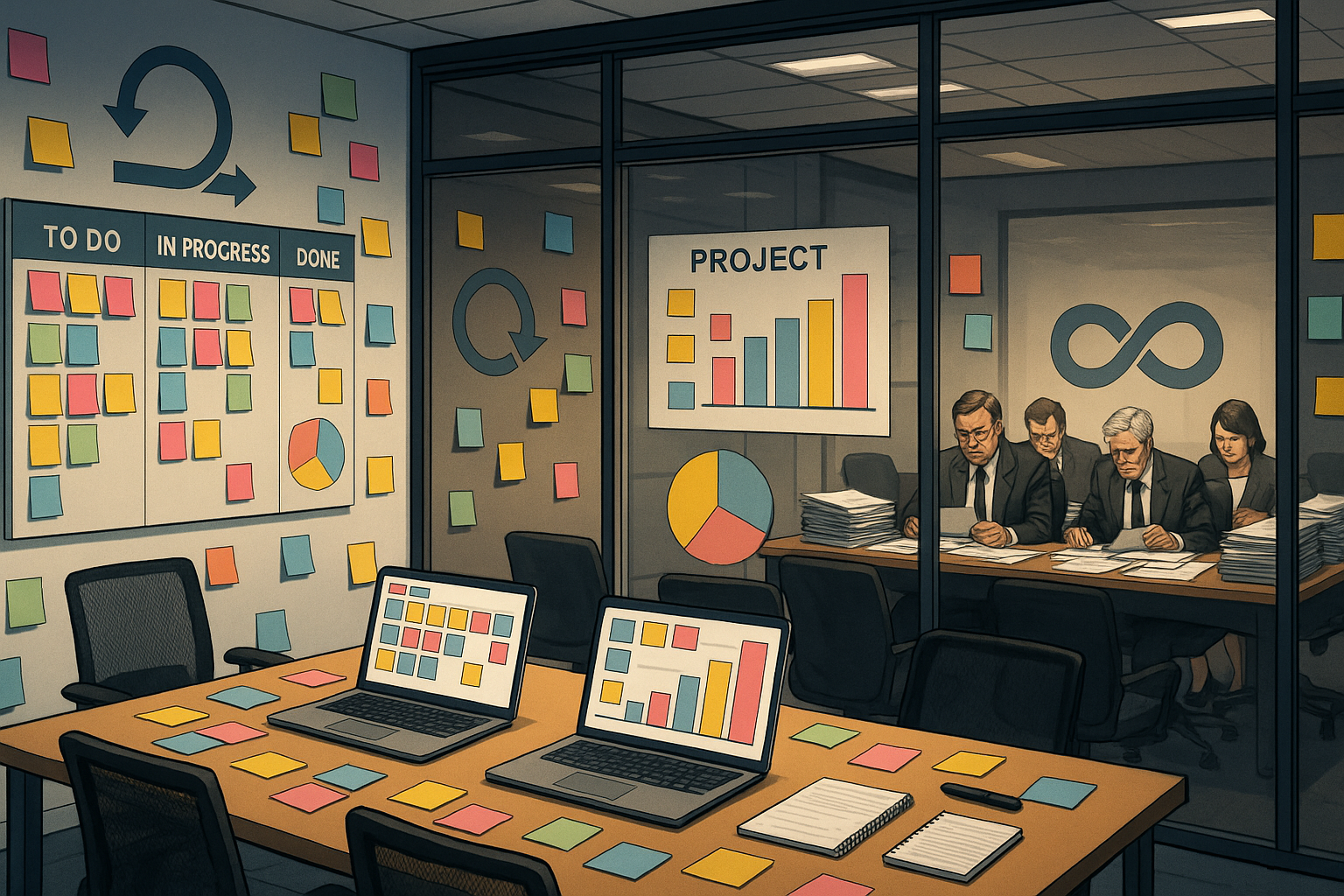
Many companies implement post-its, Agile ceremonies and digital dashboards, but continue to operate with bureaucracy, rigid hierarchies and lack of customer focus. The result: frustration in the teams and disappointment in the steering committee.
From the steering committee’s perspective:
- Investment with no visible return: “We have invested in coaches and tools… but the time-to-market remains the same”.
- Team fatigue: “They say Agile is more load, not more agility”.
- Culture clash: “Autonomy vs. control… two languages coexisting without coherence”.
- Strategic doubts: “Are we transforming the business or just doing Scrum in IT?”
From this level, the main concern is not the daily or the sprint, but the disconnect between business strategy and Agile execution. When the committee sees that the teams are doing Agile but the company is not more competitive, the easy conclusion is: “Agile doesn’t work”.
But beware:
it’s not that Agile doesn’t work, it’s that the transformation hasn’t reached the level where the big decisions are made.
In my experience, there are 10 clear symptoms that indicate that Agile isn’t working:
- Agile as organizational makeup
- Leadership that doesn’t change = Agile that doesn’t work
- Infinite meetings, scarce value
- Lack of shared purpose
- Metrics that measure the wrong thing
- Defensive culture and resistance to change
- Agile limited to IT
- Poorly managed complexity
- Confusing agility with improvisation
- Retrospectives without impact
1. Agile as organizational makeup
Agile as organizational makeup
This is the clearest symptom of a false transformation. The company adopts Agile jargon, such as“sprint” or“backlog“, but the way of working remains the same, with excessive bureaucracy and control. A clear example of Agile as decoration.
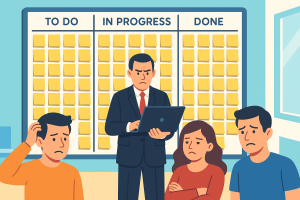
- Ornamental Kanban boards: Teams use boards, but decisions are still made hierarchically and work comes in via email, not the board. This is a classic Agile problem.
- Dailys that are monologues: Daily meetings become status reports to the boss rather than a space for team coordination.
- The name is changed, not the form: Projects are renamed sprints, but still planned and delivered in the traditional way, with no incremental value.
The form is changed, not the substance. And that never generates value.
2. Leadership that doesn’t change = Agile that doesn’t work.
The agile leadership is fundamental. If leaders do not change their control mentality, change will not prosper.
- Endless committees: Key decisions get bogged down in lengthy committees, killing the speed of teams.
- Velocity metrics, not impact metrics: Teams are rewarded for the amount of work they complete, not for the value they generate for the customer.
- Micromanagement: Managers control every step instead of empowering their teams, which nullifies the autonomy promoted by Agile. Becoming micromanagement disguised as ‘monitoring’.
- Speeches of autonomy: practice of control. Many leaders sell freedom, but then intervene in everything. This incoherence generates cynicism: teams stop believing in transformation.
Without adaptive leadership, there is no sustainable agility.
3. Infinite meetings, scarce value
When Agile doesn’t work, teams complain of “more meetings and less time to work.”
This symptom is very striking because the team complains that the meetings generate fatigue instead of learning.
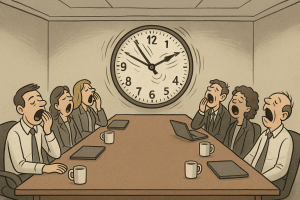
- Multiplication of meetings, but no clear decisions. When Agile becomes more meetings that solve nothing, productivity drops. Collaboration time becomes attrition.
- Daily converted to report to the boss. If the daily is not used to identify blockages or coordinate the team, but rather to be accountable, it has lost its function.
- Retrospectives used as “group therapy” without improvement actions.
Retrospectives are not places to complain without consequences. If improvements are never implemented, the team becomes frustrated and loses faith in the process. - Long meetings that replace real collaboration. Agility looks for useful and brief conversations. If we spend the day in meeting rooms without delivering anything, something is wrong.
Agile is not synonymous with more meetings. It’s about better conversations.
4. Lack of shared purpose
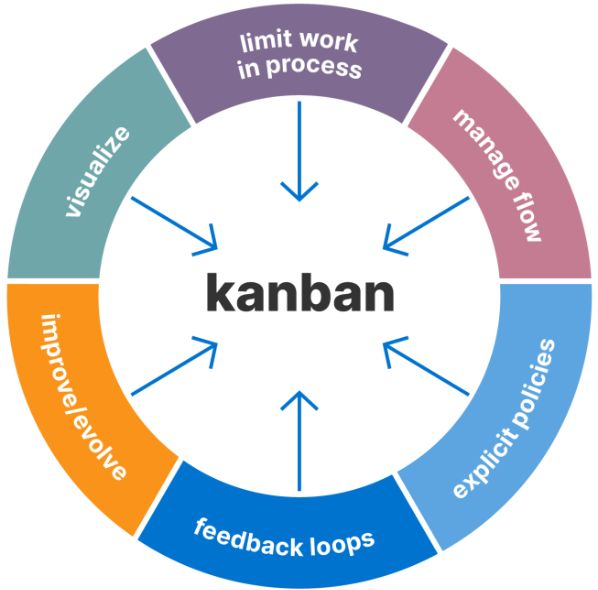
Many organizations copy frameworks (Scrum, SAFe, Kanban) without answering the “why”. Agile is used as an end in itself, not as a means to deliver value.
When an organization adopts Agile without a clear purpose, it is perceived as a fad imposed from above.
- Agile without a “what for”: No explanation of why Agile is being adopted or how it connects the team’s work to the business strategy.
- Misalignment: Each area interprets Agile in its own way, creating inconsistency and confusion.
- Practices applied out of fashion, not necessity.
Without a clear purpose, agility is just another trend.
5. Metrics that measure the wrong thing
If your metrics are still “hours worked” or “deliverables completed” or (controversially) “story points”, you are measuring activity, not impact.
It is very evident that the organization lacks real customer value metrics.
- Focus on hours worked and not on value delivered. Measuring success by busy hours is still in an industrial mindset, not a value mindset.
- 100% occupancy reports as “success”. Having everyone saturated is not efficiency. It is a trap that prevents adaptation.
- Celebrate fast deliveries… even if the customer doesn’t use them. What matters is not how many things we launch, but how many things we actually bring to the customer.
- Metrics that reflect activity, not real impact. Counting done tasks does not equal impact. Agile focuses on results, not movement.
What is not measured with meaning, is not improved with impact.
6. Defensive culture and resistance to change
Cultural inertia is one of the biggest obstacles to a successful agile transformation. Phrases like“we’ve always done it this way” are a clear symptom.
- “We’ve always done it this way”: This defensive mindset blocks experimentation and change.
- Fear of error: If making mistakes is punished, no one will dare to try new things, and without trial and error, there is no learning.
Agile transformation is blocked when the organizational culture is left untouched.
7. Agile limited to IT
If Agile is only applied in the technology department, bottlenecks are created and the transformation does not scale.
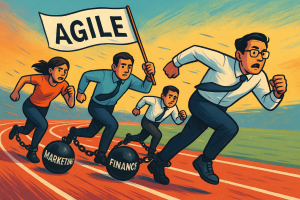
- Launches are blocked pending external approvals. The value delivered is slowed because other areas do not have the same cadence.
- Human Resources continues to hire with rigid and slow processes. While IT seeks agility, HR takes months to fill vacancies. Pure inconsistency.
- Agile remains isolated in one department, with no cross-functional impact. A company is not agile if only one area is agile. Agility must be breathed throughout the organization.
Agility is transversal. If it does not reach the entire organization, it is not agility.
8. Poorly managed complexity
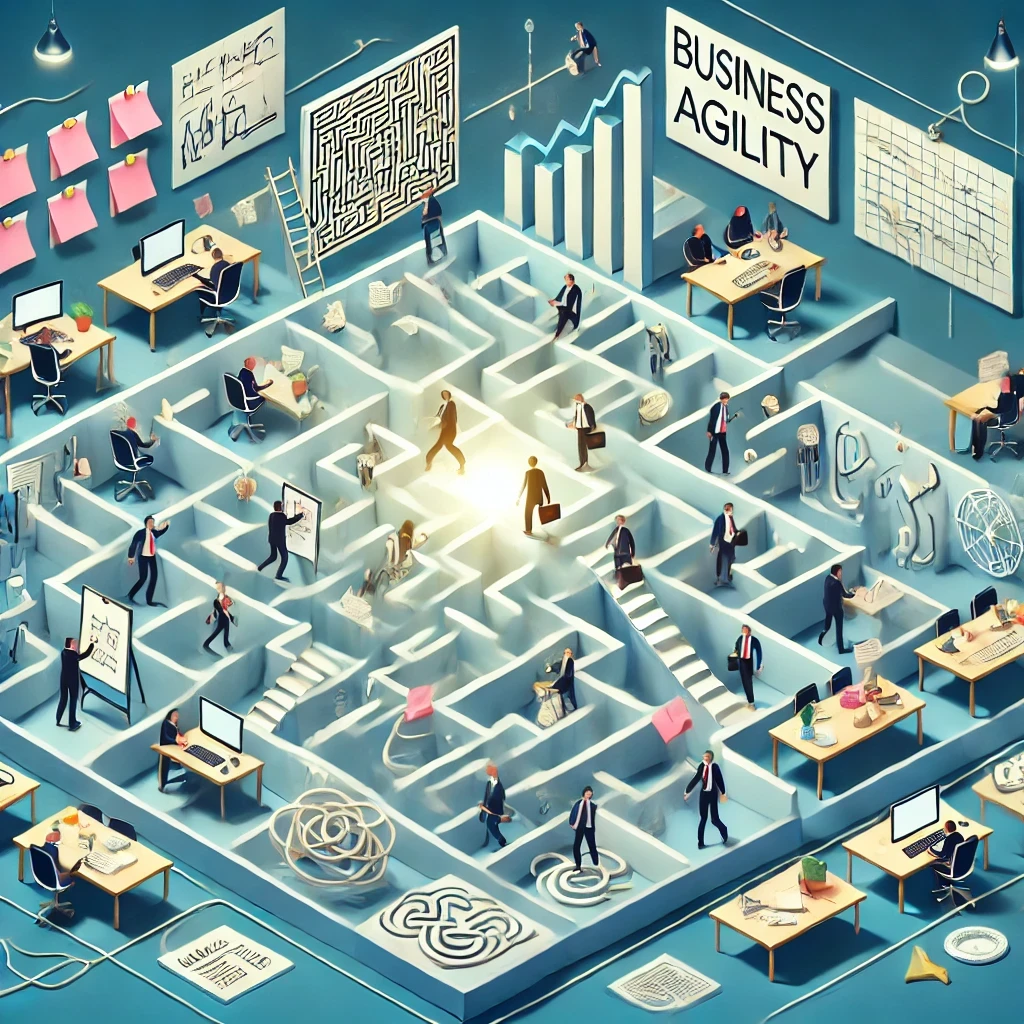
A very common symptom is trying to manage complexity with more processes, more reports and more bureaucracy.
This can be seen in that people are working more, but generating less value.
- More bureaucracy every time a new challenge appears. The typical response to chaos: more rules, more processes. Result: slowness.
- Proliferation of reports and meetings of no use. Managers tied to reports and committees, with no time to lead teams.
- Duplicated processes that generate slowness and frustration. Several areas ask for the same thing, in different ways. Duplicate work, null value.
- People working longer hours… but generating less value. Overload is a symptom that internal complexity is eating us up.
Agile seeks to simplify the complex, not add more layers.
9. Confusing agility with improvisation
Agile is not chaos or improvisation. It plans, but in an adaptive way. It is common to confuse working with iterations with working in chaos mode and with disorder.
- Planning is eliminated because “Agile is flexibility”. Common mistake: thinking that Agile means no planning. In reality, there is more planning, but in an adaptive way.
- Constant changes in priorities without explanation. If the agenda is rewritten every week without sense, the team goes into chaos.
- Lack of focus on what really matters to the customer. Without a clear direction, movement is confused with progress.
- Iteration confused with chaos and lack of direction. To improvise is to improve step by step. To improvise is to do without direction.
Agile requires clear direction, strategic focus and adaptation, not chaos.
10. Retrospectives without impact
Hindsight should be the engine of continuous improvement. But in many companies it becomes an empty ritual. It is classic to see improvement actions identified that are never implemented.
- Teams that do retrospectives… but never implement improvements. Retro loses credibility if nothing changes in practice.
- Repetition of the same problems sprint after sprint. If there is no follow-up, problems are recycled over and over again.
- Use of retro as a space for complaints, without solutions. A wall of wailing does not improve the delivery of value.
- Retros that end with no clear actions and no accountability. Without decision-makers, ideas remain in the air and do not generate evolution.
A good retrospective doesn’t end in a list. It ends in real change.
So… Agile doesn’t work?
This is the million dollar question. And the short answer is: yes, it works… but not always, and not in all conditions.
The real question is: Are we creating the conditions for Agile to work? If the answer is no, what you will see are all those agile doesn’t work symptoms: empty ceremonies, cultural resistance, wrong metrics and widespread frustration. At SmartWay, as an Agile consultancy we help your company.
Agile works when these key ingredients are in place:
- Clear purpose: If there is no shared “what for”, agility becomes a set of empty rituals. What do we want to be more agile for? To deliver faster? To innovate? To adapt to the marketplace? If there is no answer, failure is almost certain.
- Transformed leadership: If leaders continue to operate with control logic, Agile becomes a contradiction. Teams will never feel autonomous if decisions remain centralized.
- Learning culture: Agile is not about working faster, it’s about working by learning faster. That means testing, making mistakes and adjusting. If your organization penalizes error, agile dies in the first iteration.
- Impact metrics, not activity metrics: Hours worked ≠ value delivered. What matters is how much impact we generate in customers, not how many sprints we close.
- Agility beyond IT: A company cannot be agile if it is only agile in one corner. If marketing, legal, finance and HR remain in bureaucratic mode, the whole effort becomes a funnel.
So… why do we say Agile doesn’t work?
Because we misuse it. Because we confuse tools with culture. Because we believe that by changing processes, we automatically change the mentality.
Recently, a company was telling me, “We did dailies for six months and didn’t improve anything.” When we checked, we discovered that the dailys were
One thought: Agile is not the problem. The problem is using Agile as a makeover instead of a real transformation.
In short, the next time you hear that Agile doesn’t work, consider that the problem is not the methodology, but the lack of a real transformation that embraces leadership, purpose and customer satisfaction.
Conclusion: Stop making up, start transforming.

The next time you hear “Agile doesn’t work,” ask yourself: Are we seeing symptoms of a false transformation?
Agile is not about post-its and ceremonies, it’s about leadership, purpose and happy customers. Because yes, Agile works. What doesn’t work… is wanting to change without changing anything.