
Your start-up is finally taking off!
Obviously there are many desires to do new things and to innovate and learn, and with this it is normal to think about new frameworks and methodologies that can contribute. Design Thinking, Lean Startup, Agile, everything that can help us on this new path, we want it and we need it now!

What is an Agile Startup?
If we have learned anything in recent times, it is that today’s world requires us to be able to adapt to it. Changes are constant, and since 2020, we know we must be ready.
An Agile Startup is one that without ceasing to add value and focus on its customers, is able to adapt to new conditions and take new opportunities. It is something like if your company learns to surf.
And how important is Agile in the entrepreneurial ecosystem?
Agile is important in the entrepreneurial ecosystem because it will help us deal with a constantly changing environment, not only externally but also internally.
Our startup right now has a certain shape, size and structure, but in order to succeed, these attributes will surely change as well.
We need to be able to adapt at a technical level and also at a mindset level.
Agile in the entrepreneurial ecosystem helps startups to gain ground, and incorporate customer feedback, to have an increasingly desirable product for our customers.
So as you can see integrating this philosophy is very important if possible even from the beginning.
Agile, Lean Startup, Design Thinking, which one to use?
Understanding the Lean Startup Methodology
The Lean Startup methodology is like the scientific method, it allows us through experimentation and observation to understand the environment, test, experiment, and depending on the results change course. This is how mankind has managed to discover new things and get so far, so will your startup soon!
What about Design Thinking?
It allows us to have products and services focused on the user. Always with our customer being the main focus and discovering and testing new ways to please and retain them. It helps us to create products and experiences through a deep understanding of our customers.
The Synergy between Agile, Lean Startup and Design Thinking
Now that we know a little more about each of them, it’s easy to see why combining them makes for a triad of business success.
Suppose we are in the year 2923, science has made the seemingly impossible possible and we can now travel to any point in the galaxy in a short time (yes, we managed to overcome all the restrictions that now seem impossible).
In this environment, you realize that there are many possibilities to create new businesses, for inhabitants of Earth, but also of other planets. The possibilities are endless.
Design Thinking will help you to better understand each of your potential customers, Lean Startup to test your ideas, and Agile to strengthen your company to be adaptable and focused without neglecting quality.
But can Agile help me maintain quality?
Strategies for Implementing an Agile Approach Without Sacrificing Quality
Agile and quality are not at odds. This can only happen when we lose sight of our goal on our way.
Or when, because we want to cover everything, we end up having goals that overlap with each other.
That is why when starting with any methodology, it is best if we surround ourselves with experts, who can help us to clearly define what is best for our specific case.
3 Key Steps to Implement Agile Methodology in your Startup
We know you are anxious but do it without rushing.
Think carefully about your product and the current structure of your company, what is the best way to go?
Remember how each methodology can help you. Think of your startup as a product itself, what would be the MVP, we know you want it all, but analyze it and do it calmly.
We can give you 3 initial steps for this:
1. Analyze and define your objectives, short, medium and long term. What is your vision? Defining this will serve as a compass so that you will always know where you are going.
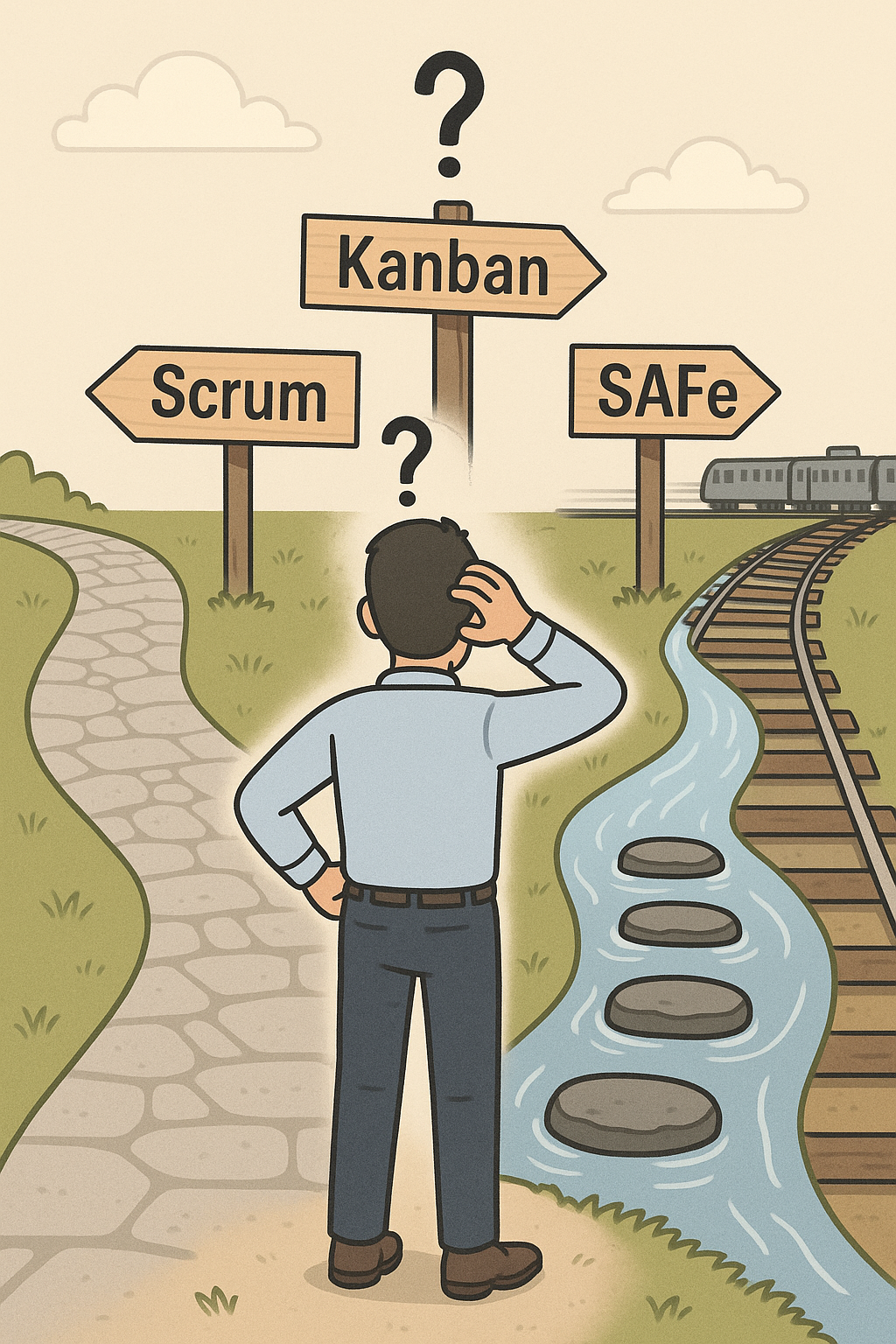
2. Surround yourself with experts, which Agile framework is right for you and when? Scrum, Kanban, SAFe? One first and one later or all at the same time? These are not simple answers, nor is it a one-size-fits-all mold; every company is unique.
Be patient, there will be many changes and many decisions to make, and patience is important to make the best decisions.
Conclusion: Startup Evolution through Agile, Lean Startup and Design Thinking
As I said at the beginning. There are many super interesting methodologies. We want to apply all of them, because they are fashionable, they sound good and there are many publications on social networks about it and in this new stage of entrepreneurship we would like to absorb everything and keep as much as possible. But maybe this is not the way.
It is important to make decisions with an awareness of what we expect to obtain.
The anguish to get afloat and succeed is real, at the end of the day, the fact that our new company is alive, came from a dream, and we want this dream to succeed. It is almost personal.
We commonly find an almost immediate hiring of UX, UI, Research, and Agile profiles, which is a very good strategy as long as it has been analyzed, planned, and is what will really add the most value (always value first), but what benefits do Agile and Lean specifically bring to a startup?
How can we benefit most from the numerous frameworks, and especially which one to choose?
Applying Agile helps us to prioritize value over fashion, and to understand its foundations. This implies having teams focused on the customer, from the beginning.
And that is important, focused on the customer, and not filling ourselves with everything that exists in the market, even though it may not be useful later on.

With Lean and Agile we can iterate both with the product and with our new company, pivoting as many times as necessary. We have to foster the mindset that allows us to do this, because there will be frustrating moments and moments where even though we are already comfortable, we see that what will create more, is a sometimes unwanted change.
Experimenting, even with fear, should be one of our main objectives. And of course it can be scary, after all, we are starting out, we want to push our product, have more customers, and at the same time we need to optimize finances, pay payroll, worry about investors.
And with all this stress, how can I dare to experiment? I need everything to go right the first time.
And this is where Agile can help us overcome these fears, because experimenting is not incompatible with having good indicators, we need to live in continuous improvement, of course. But with evolutionary changes. Little by little and knowing where we want to go.
And if our goal changes, stop, breathe, and even in fear turn.
The scientific method works, it has always worked, and every leap into the void is rewarded if it has foundations and a clear vision.

Will there be problems? Of course there will be. But we will be able to adapt. And I’m convinced that Agile can help us do that.
The key? Working with people who can really help us understand what’s best for us, without marrying us to any one idea, even if it’s a mix of frameworks. Experts who can help us make our own decisions with a conscience, and give us their vision, at least at the beginning. If you want us to help you we can do it!
The worst is over, we made it, and we have to be prepared for the challenges ahead, it is not an easy road but surely the best is yet to come.