At this time of the year, many of us review how the previous year has been, or how we are doing in life at various levels. This is also a time when we consider changes, to get closer to a desired version of ourselves:
Let’s create our New Year’s resolutions!!!!
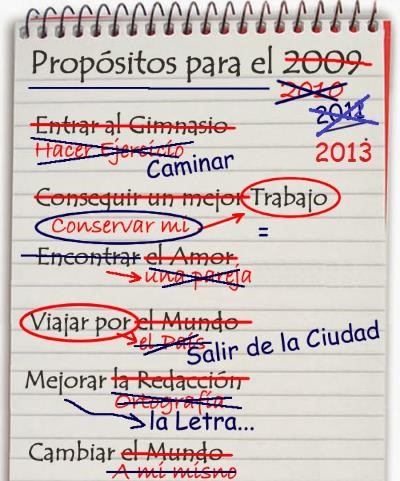
Why at this time of year?
There are several periods during the year when these moments of reflection and goal setting are more frequent: the beginning of a new year and after the summer, at the “back to school”. This is because at this time of year there have been or are changes in our routines. It is logical that it should take place at this time, since having such socially marked dates gives us a structure, a starting point. In my experience, a structure is necessary to carry out the first changes, and it allows us to have a starting point.
But this structure is only a starting point. Changes continue to be difficult, costly and most of them are not of immediate effect. When these changes have immediate effects, the challenge is usually to maintain them over time.
In this post I would like to share a couple of tools that will help us to carry out our desired changes. The first key is to establish the objectives well and the second is to prioritize them appropriately.
Prioritize your objectives
Prioritizing is fundamental, we must be clear that it is very difficult to change many things at the same time. Our capacity to start new projects/habits is infinite but our capacity to finish them is finite.
As I explain in the “ProductividUP” ebook, “if everything is important, nothing is important”: choose your goals wisely!
Making too many changes in your routines at once doesn’t usually work, which is why it is advisable to prioritize your New Year’s resolutions. Let’s start with the one we consider to be the highest priority, because it brings us the most value or because it is the one we want the most.
Maybe building just one new habit is too little, and we want more changes, in my experience introducing more than 3 habits at a time requires too much energy.
But before we talk about habits, let’s talk about objectives.
My Objectives
Let’s assume that my goals for this year are as follows:
- Enhancing my personal brand
- Read more
- Finishing a marathon
- Playing the guitar
- Learn German
The first thing to do is to prioritize. Realistically, for me, trying to achieve all of these goals at once is unlikely. So let’s start with the ones that can bring me the most “value”:
- Read more
- Finishing a marathon
My OKR
These are an example of objectives, as valid as any other. These are good objectives, as they are inspiring and challenging, although it is difficult to measure whether or not they have been achieved. This last point is very important in relation to the motivation for its achievement, and is closely linked to dopamine.
Dopamine is the neurotransmitter responsible for propagating nerve signals between connected neurons. Its main functions are pleasure (especially if it is anticipatory), motivation (the “want to do”) and learning, among others. Being able to see the progress (or lack thereof) in achieving our goals is fundamental to continue to fuel our motivation. Seeing progress even allows us to make decisions to improve results.
In order to measure our progress towards an objective in an easy way, we will make use of Key Results (KR).
KRs are actions or their objectives that are easily measurable and are fully linked to the primary objective. These Key Results are what we will measure after a reasonable period of time, perhaps 2 or 3 months. They will help us to assess whether to continue, modify or redirect new KRs to get closer to the main objective.
The Key Results should be:
- Quantitative: it must express a magnitude.
- Easily measurable
- Preferably ambitious, but by no means impossible, but it is a great challenge to reach 80% of it.
- We seek to measure results, although it can also be at the milestone level (done or not done).
- There must be no doubt about what we measure, it must be clear.
- Related to a time frame.
- They must have an impact on the overall objective.
- Typically, 3 to 5 KR are generated per target.
As we can see, OKRs also follow the SMART (Specific, Measurable, Achievable, Relevant, Time-related) criteria like any other approach to achieving objectives.
For the above examples:
- Read more (O)
- Read 2 books per month.
- Listen to 3 podcasts per month.
- Read one blog post per week.
- Finish a marathon.
- Run 5 km in 25 minutes
- Do a series of planks 5 times a week.
- Read one book a month on nutrition for sportsmen and women
- Run an average of 30 km per week.
- Do 2 spinning sessions per week.
The KRs are not my direct goals, but their attainment (albeit partial) should bring me closer to my objectives.
Periodic reviews

One of the strongest points of OKRs is the periodic reviews. From time to time, typically every 3 months, an assessment is made of the KRs associated with each of the Objectives. The percentage of completion of each of the KRs linked to each objective is evaluated. Also how these KRs have impacted the overall objective. During this evaluation, we reflect on whether to continue with the same KRs, modify the existing ones or add new ones.
The frequency of review will depend on the length of time the objectives are prescribed, although in my personal experience reviews should not extend to periods longer than 2-3 months.
And this is done by some companies?
Companies also set their annual objectives. There are many ways in which companies try to achieve these objectives, and one of them is OKRs.
This tool allows organizations to align around common general objectives and has been used for years by companies such as Google, Intel, Spotify, Disney, ING or Linkedin in a very successful way.
Today, there are quite a few companies and even departments that use OKRs to work on the overall objectives of the organization. This allows them to prioritize (or filter) which day-to-day projects or tasks are carried out and which are not, and to support the achievement of the overall objectives.
In a future article we will go into more detail on ideas on how to implement OKRs in an organization.