Strategy vs Tactics: An Introduction to Strategy and Tactics
What do Napoleon, Steve Jobs and Kasparov have in common?
They are known for being great strategists. And they are so in fields as disparate as the military, business, or chess.
None of them would ever start their moves (military, business or chess pieces) on the spur of the moment, but on the contrary: they make well thought-out moves to achieve their goal, be it victory over the opponent or something else. These well thought-out moves are the application of a tactic, which in turn is the concrete application of a strategy.

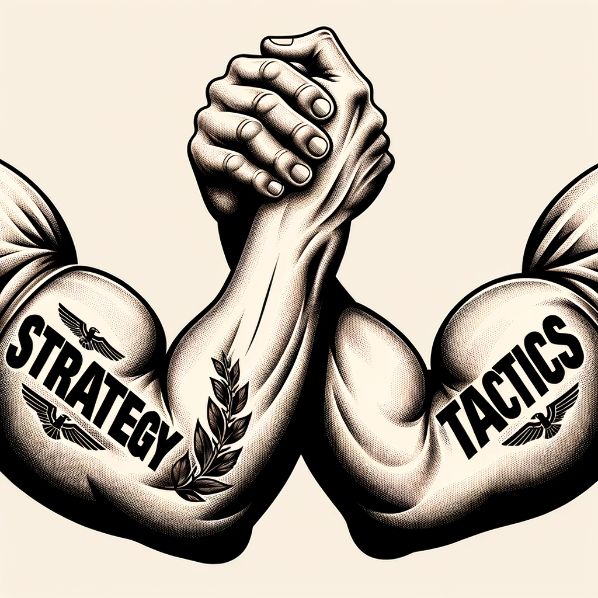
Often, “strategy” and “tactics” are used interchangeably to describe “the plan to achieve an objective”. But a closer look reveals their relationship and differences. You have to think strategically and then apply concrete tactics.
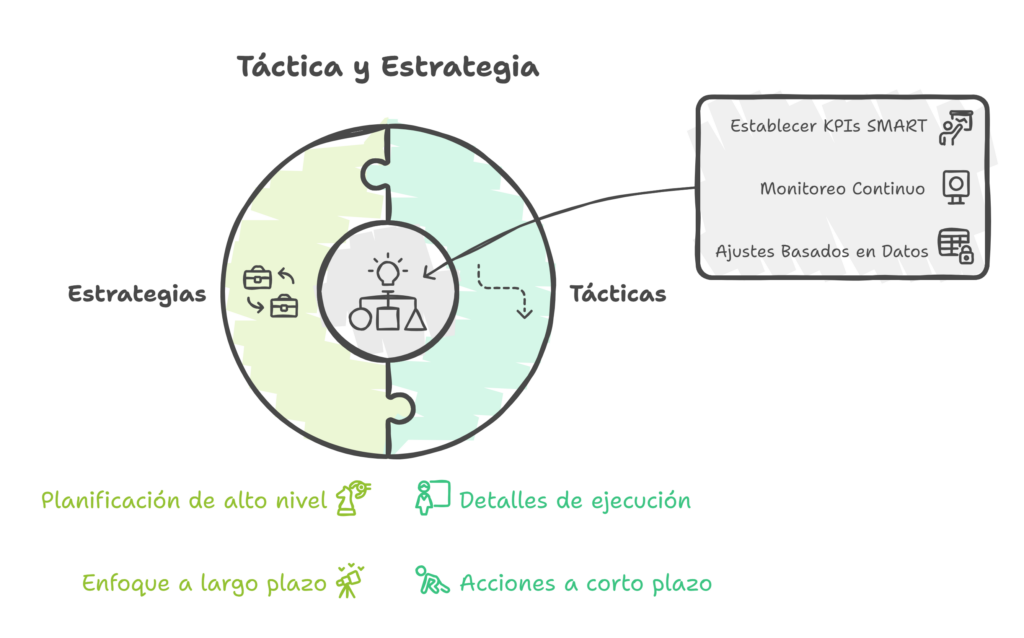
Strategy is the direction I want to take to achieve my long-termgoal.
Strategy is the broad outline, a framework that guides the direction and focus of an organization, setting out the principles and vision to be followed.
The tactic is the detail of how I put the strategy to work in the short term.
The tactic is the concrete actions and decisions I will make to carry out that strategy.
Like those great strategists mentioned above, you can use strategy and tactics to achieve your personal or organizational goals.
Breaking down Strategy and Tactics: What an effective strategy must have
An effective strategy is always based on a long-term vision. This involves understanding not only where you are now, but also where you want to be in the future.
Define the purpose and final destination of your company or project, oriented to global results. It requires a thorough analysis of the environment, competitors and own resources. Any effective strategy should include indicators or metrics to evaluate its progress on a regular basis.
In the context of OKRs, we must consider that the strategy must have aspirational objectives.

What a successful tactic must have
If we want to achieve a successful tactic there are a series of elements that we must take into account that will help us:
- Clear and defined objectives, ideally using the SMART method.
- Flexibility. They will be tactics capable of adapting to changes in the environment, and of responding effectively to unforeseen events, always in line with the strategy.
- Concreteness, with focus on specific details.
- Immediate applicability, since the tactic is oriented to the short term.
Differences between Strategy and Tactics in different areas
In this section we will look at examples of strategy and tactics in different environments, for example military, chess, digital marketing and business.
Difference between Tactics vs. Military Strategy
Strategy defines the “what” and “why” of military operations, while tactics deals with the “how”. For example:
- Strategy: The Allied strategy during World War II was to open a front in Western Europe to relieve pressure on the Soviet Union and move toward Germany to defeat the Axis.
- Tactics: Tactics included the use of paratroopers to secure key bridges and routes behind enemy lines, air and naval bombardment to weaken German defenses, and amphibious assault on the Normandy beaches to establish a beachhead.
Difference between Tactics vs. Chess Strategy
Tactics in chess refers to concrete maneuvers and sequences of moves that have an immediate and calculable objective, with a short-term impact on the game. Examples: moves such as double check, pinning, overdrafts, tactical sacrifices, and forced mates.

Strategy in chess refers to long-term planning. It focuses on improving the overall position, preparing future actions, and weakening the opponent’s positions gradually. The strategy may not have an immediate impact, but it sets the stage for future tactical successes. Examples: the choice of openings, control of the center of the board, management of the pawn structure, and exploitation of the opponent’s weak squares.
Difference between Tactics vs. Digital Marketing Strategy
In digital marketing, strategic planning involves defining long-term objectives, such as improving brand recognition or increasing online sales, and determining key channels and audiences.
Tactics in this area include email campaigns, social media advertising, search engine optimization (SEO) and content marketing, all designed to deliver on strategy.
Example: let’s consider the objective of increasing web traffic by 30% in six months. The strategy would be to “improve online visibility and brand recognition through relevant content and SEO”. Tactics would include “creating and publishing weekly blogs on topics of interest to our audience”, “using targeted keywords to improve SEO” and “promoting content through social media”.
Difference between Tactics vs. Business Strategy
At the company-wide level, strategy could involve expansion into new markets or product diversification, while tactics would be specific actions such as product launches, alliances with other companies, or targeted advertising campaigns.
Strategy, Tactics and Tasks: the planning hierarchy
Tasks are the specific, day-to-day actions performed to execute the tactics. These are the concrete steps that ensure that the tactics effectively support the strategy.

In business management, one strategy may be to “increase customer satisfaction”. Tactics could include “improve customer support,” while tasks would be actions such as “respond to customer inquiries within a specified time frame.”
Key Indicators: measuring the success of Strategies and Tactics
Measuring the success of both strategies and tactics is critical to any organization. Key Performance Indicators (KPIs) are essential tools for this, as they are a quantitative way of evaluating the effectiveness of the actions implemented.
For KPIs to be effective, they must be integrated into all stages of strategy and tactics planning and execution. This involves:
- Establish SMART KPIs: for both strategies and tactics, KPIs should be specific, measurable, achievable, relevant and time-bound.
- Continuous Monitoring: regularly review and analyze KPIs to ensure that strategies and tactics are on track.
- Data Driven Adjustments: react with strategic and tactical adjustments according to the results observed in the continuous monitoring of KPIs.
Indicators for Strategies
KPIs for long-term strategies should be aligned with the organization’s overall objectives. As examples, KPIs could include market share, revenue growth or customer retention. In a digital marketing strategy, a KPI could be “increase organic website traffic by 40% in the next year”.

Indicators for Tactics
KPIs for tactics are more specific and focus on short-term results. In digital marketing tactics, some KPIs might include click-through rates on an email campaign, web traffic or short-term sales conversions. For example, a KPI could be “increase the click-through rate (CTR) of the email marketing campaign by 5% in the next quarter”.
Communication and Branding: the intersection of strategy and tactics
Communication and branding are areas where the distinction and interplay between strategy and tactics are particularly evident and crucial to success.
Communication Strategy
A comprehensive communication strategy is a long-term plan that defines how a company communicates with its audience, customers and other stakeholders. This strategy includes: Target Audience Identification, Key Message and Brand Positioning and Communication Channels. For example, one strategy might be to “position the brand as a leader in technological innovation in photography”.

Branding Tactics
Branding tactics are the specific actions to implement that communication strategy. These may include: advertising campaigns, content marketing, events and sponsorships. Taking the above example, one tactic might be to “launch a series of advertisements focused on the technological innovation of new cameras”.
Strategy vs. Tactics: application in agile methodologies
When we want to apply Agile methodologies on strategy and tactics, it is necessary to consider several points:
- Strategic planning
- OKRs
Agile and Strategic Planning
Agile methodologies fit perfectly with strategic planning, as the agile manifesto promotes continuous review and adaptability in response to changes in the environment, even for strategy focused on the long term. Unlike multi-year strategic plans that were only reviewed at their completion after several years, Agile promotes more frequent reviews, p. e.g. roadmap with quarterly or semi-annual milestones.
Implementation of Agile Tactics
Tactics, because of their focus on the short term, benefit even more than strategies from this agile approach in the speed of adaptation in response to results and frequent customer feedback.
The various agile methodologies provide tools that facilitate the incorporation of this speed of adaptation.

Strategy vs. Tactics: OKRs
OKRs connect strategy (where the organization wants to get to) with tactics (how it will get there), ensuring that all activities are aligned and contribute to the organization’s overall objectives.
Alignment with Strategy: OKRs begin with the definition of objectives that are directly aligned with the organization’s vision and strategic goals. This ensures that all efforts are directed towards the same strategic goals.
Breakdown into Tactics: Key results break down these strategic objectives into specific, measurable, action-oriented tasks. They act as a bridge between long-term objectives and day-to-day actions.
Flexibility and Agility: OKRs allow you to adapt to rapid changes in the business environment. While objectives may remain stable, key results can be tactically adjusted to respond to changing needs.
Focus on Results: By focusing on key results, OKRs avoid the trap of confusing activity with productivity. This keeps the organization focused on the actions that really drive progress toward strategic objectives.
Transparency and Collaboration: OKRs promote transparency by making objectives and their progress visible to everyone in the organization. This fosters collaboration and understanding of how individual and team contributions align with the overall strategy.
Ongoing Review and Adjustment: Regular OKR review cycles (quarterly or monthly) allow progress to be evaluated and tactical adjustments to be made. This ensures that the organization stays on track and adapts to changing circumstances.
Conclusion: Integrating Strategy and Tactics for Success
We hope that the many examples we have shared with you have inspired you to action.
To achieve organizational success, it is crucial that strategy and tactics are aligned and mutually reinforcing. A well-defined strategy, supported by efficient tactics and well-executed tasks, as well as adequate progress indicators that allow us to pivot when necessary, are the key to achieving long-term objectives.